These notes were written by the person who submitted this item. Appraiser.AI has not verified them, and the AI's identification and estimate may rely on them.
AI Estimated Value
Not an official valuation
$50 - $120
AI estimate as of November 28, 2025 · verify with a professional before acting
AI-Generated · Verify before acting
Everything on this page is generated by AI for informational purposes only. AI can make mistakes — the AI may misidentify items or misattribute them (artist, maker, brand, designer, origin, era). This is not an official valuation and should not be used for insurance, sale, tax, estate, legal, or lending purposes — or any decision requiring a certified appraisal. It is not an authoritative claim about any person, brand, or rights holder — do not share or rely on it as a factual statement about a third party. Always consult qualified professionals before making financial decisions.
This analysis also relies on unverified notes provided by the user, which may be incomplete or inaccurate and could affect the result.
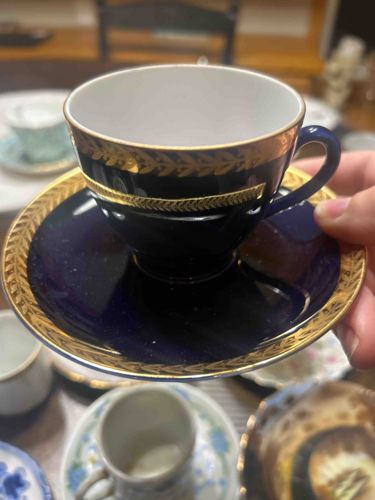
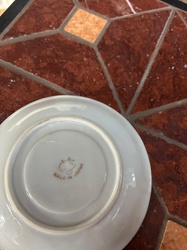
This exquisite demitasse cup and saucer set features a deep, lustrous cobalt blue glaze as its primary color, beautifully contrasted with intricate gold detailing. The cup has a classic, elegant shape with a gently flared rim and a C-shaped handle, seamlessly integrated into the body. The interior of the cup is a pristine white, providing a visual break from the dark exterior and highlighting the contents. A broad band of ornate gold decoration, reminiscent of a laurel or vine motif, encircles the exterior of the cup just below the rim. Below this, a narrower band of geometric gold pattern, possibly a herringbone or chain link design, adds further visual interest. The saucer mirrors the cup's design, with a wide band of the same intricate gold leaf pattern along its rim, framing the deep cobalt blue center. The set appears to be made of porcelain or fine china, a typical material for such delicate tableware. The gold decoration exhibits a high level of craftsmanship, suggesting hand-applied gilt rather than a decal, which speaks to its quality. While specific manufacturer's marks are not visible in the provided image, the context "Made in USSR" indicates its origin, placing its estimated age sometime between the mid-20th century to the early 1990s. The overall condition appears excellent, with no immediately visible chips, cracks, or significant wear to the gilding, which would typically show as fading or rubbing on older pieces. The glossy finish of both the cup and saucer suggests minimal use or careful preservation. This set embodies a refined aesthetic often associated with formal tea or coffee service.
AI Appraisal Report
I have thoroughly examined the provided image of this USSR-era Cobalt Blue and Gold Demitasse Cup and Saucer. Visually, the set appears to be in excellent condition, showing no immediate signs of chips, cracks, or significant wear to the vibrant cobalt blue glaze or the intricate gold detailing. The high-gloss finish suggests careful preservation and potentially minimal use. The elegance of the design, with its classic shape and detailed hand-applied gilt ornamentation, speaks to a typical level of craftsmanship for higher-end Soviet-era porcelain. The 'Made in USSR' attribution places its origin definitively between the mid-20th century and the early 1990s.
Regarding market conditions, USSR-era porcelain, particularly demitasse sets, holds a niche appeal among collectors interested in Eastern European ceramics and Cold War memorabilia. While pieces from major factories like Lomonosov (now Imperial Porcelain Factory) can command higher prices, generic 'Made in USSR' items, though often well-made, typically trade in a more accessible price range unless they possess exceptional artistry or historical significance. Comparables frequently available on online marketplaces and at estate sales for similar, well-preserved demitasse sets suggest a value range reflecting this.
Factors significantly impacting value include the excellent condition and the detailed gold work, which appears to be hand-applied rather than a decal, indicating better quality. However, the lack of specific factory markings limits its ultimate collectible value, making it more decorative than a highly sought-after provenance piece. Demand remains consistent for attractive vintage tableware, but rarity is not exceptionally high for generalized Soviet porcelain.
It is crucial to state that this appraisal is based solely on visual inspection of the image. For full authentication and a definitive assessment, an in-person examination would be necessary to verify the feel and weight of the porcelain, confirm the absence of hairline cracks or repairs, and closely inspect the gilding for any subtle signs of rubbing or damage not visible in the photograph. Microscopic analysis could confirm the application method of the gilt. Furthermore, identifying any manufacturer's marks, even obscured ones, through physical examination could significantly refine the appraisal.