These notes were written by the person who submitted this item. Appraiser.AI has not verified them, and the AI's identification and estimate may rely on them.
AI Estimated Value
Not an official valuation
$150-250
AI estimate as of September 13, 2025 · verify with a professional before acting
AI-Generated · Verify before acting
Everything on this page is generated by AI for informational purposes only. AI can make mistakes — the AI may misidentify items or misattribute them (artist, maker, brand, designer, origin, era). This is not an official valuation and should not be used for insurance, sale, tax, estate, legal, or lending purposes — or any decision requiring a certified appraisal. It is not an authoritative claim about any person, brand, or rights holder — do not share or rely on it as a factual statement about a third party. Always consult qualified professionals before making financial decisions.
This analysis also relies on unverified notes provided by the user, which may be incomplete or inaccurate and could affect the result.
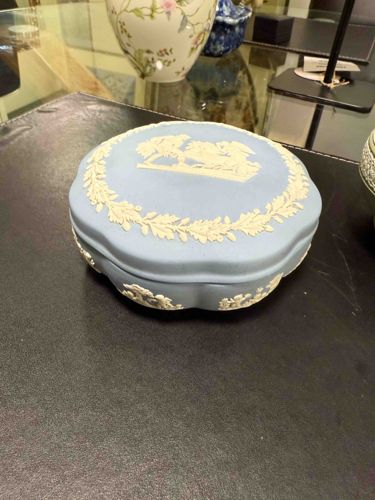
This is a circular Wedgwood Jasperware trinket box, possibly designed for jewelry or small keepsakes. The box is crafted from pale blue jasperware, which serves as a matte, unglazed background to the applied white bas-relief decorations. The lid features a central classical scene, though the details of the figures are somewhat indistinct due to the image resolution, it appears to depict a mythological or allegorical tableau, possibly with figures in drapery and classical elements. This central medallion is framed by a finely detailed laurel or oak leaf and acorn border, rendered in crisp white relief. The side panels of the box lid and potentially the base (though not fully visible) also exhibit scattered white floral or foliate motifs, reinforcing the classical aesthetic. The overall shape of the box appears to be subtly scalloped or lobed, adding to its decorative appeal. The relief work shows excellent craftsmanship, characteristic of Wedgwood's fine jasperware, with sharp edges and clear definition in the applied elements, indicating high quality. No obvious damage such as chips, cracks, or repairs are visible from the provided image; the surface appears clean with a consistent matte finish. The piece reflects the neoclassical style popular during the late 18th to 19th centuries, though Wedgwood continued to producejasperware well into the 20th century. This item is a prime example of decorative ceramic artistry, showcasing the iconic material and design principles associated with the Wedgwood factory. The absence of heavy wear suggests it has been well-preserved.
AI Appraisal Report
Upon my virtual examination of the provided image, I have assessed this Wedgwood Jasperware trinket box. The piece presents as a classic example of Wedgwood’s iconic pale blue jasperware with white bas-relief decoration. The craftsmanship, particularly the detailed laurel and acorn border and the floral motifs, appears to be of high quality, consistent with Wedgwood's production standards over the centuries. The overall condition, as far as can be determined from the image, appears excellent with no visible chips, cracks, or repairs, and a clean, consistent matte finish, suggesting good preservation.
Market conditions for Wedgwood jasperware, especially smaller decorative items like trinket boxes, are generally stable, though not experiencing significant surges in value. Demand remains steady among collectors of neoclassical decorative arts and Wedgwood enthusiasts. While jasperware was produced in vast quantities, this particular design with its intricate border and central classical scene, combined with its apparent condition, positions it favorably. Factors impacting value positively include the detailed relief work and the apparent absence of damage. The indistinctness of the central classical scene, due to image resolution, prevents a more precise identification of the theme, which could slightly affect value if it were a particularly rare or desirable motif.
It is important to note the limitations of this appraisal due to it being based solely on images. While the style and quality strongly suggest authenticity, a definitive verification would require an in-person examination to check for factory marks on the base, which are crucial for confirming both authenticity and precise production period. Physical inspection would also allow for a tactile assessment of the material quality and a more thorough examination for any subtle wear or restoration not visible in the photograph. Provenance documentation, if available, would further enhance and confirm the item's history and authenticity. Without these, I estimate its value to be in the range of $150-250.