These notes were written by the person who submitted this item. Appraiser.AI has not verified them, and the AI's identification and estimate may rely on them.
AI Estimated Value
Not an official valuation
$40 - $70
AI estimate as of September 21, 2025 · verify with a professional before acting
AI-Generated · Verify before acting
Everything on this page is generated by AI for informational purposes only. AI can make mistakes — the AI may misidentify items or misattribute them (artist, maker, brand, designer, origin, era). This is not an official valuation and should not be used for insurance, sale, tax, estate, legal, or lending purposes — or any decision requiring a certified appraisal. It is not an authoritative claim about any person, brand, or rights holder — do not share or rely on it as a factual statement about a third party. Always consult qualified professionals before making financial decisions.
This analysis also relies on unverified notes provided by the user, which may be incomplete or inaccurate and could affect the result.
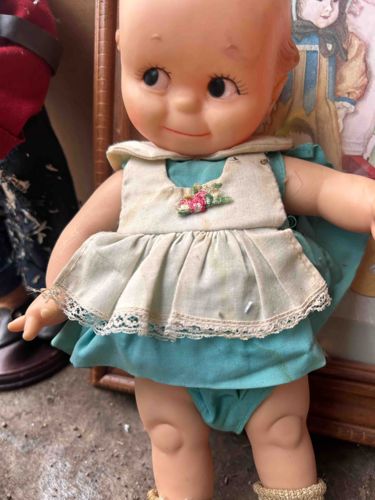
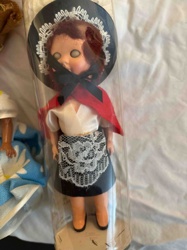
This is a vintage baby doll, likely constructed from composition or early hard plastic, characterized by its peach-toned skin and molded features. The doll has a bald head, suggesting it was either designed without hair or has lost it over time. Its face displays painted features including wide-set blue eyes with defined black pupils and eyelashes, an upturned nose, and a small, closed red mouth forming a gentle smile. There is a small bump or imperfection on its forehead and some minor scuffs visible, particularly on the forehead and left cheek, indicating wear and age. The doll is attired in a two-piece outfit consisting of a pale cream-colored bodice/dress overlay with a ruffled skirt and a teal-colored bottom layer that appears to be integrated as a dress or matching bloomers. The cream garment features delicate white lace trim around the bottom edge of the ruffle and has what appears to be a small, embroidered floral appliqué of pink and green flowers on the chest. The fabric of the clothing shows noticeable signs of staining and discoloration, particularly on the cream layer, and some creasing, suggesting it has not been recently cleaned or pressed. The doll's limbs appear jointed, with molded knees and elbows, and stubby fingers and toes, typical of baby doll designs. It is wearing what looks like knitted or crocheted ankle socks in a tan or beige hue. The overall condition, with visible wear to both the doll's body and clothing, points to significant use and natural aging. The doll likely dates from the mid-20th century, possibly 1930s-1950s, given the typical materials and aesthetic of dolls from that era. The craftsmanship, though simple, is indicative of mass production for children's toys, focusing on durability and a charming, baby-like appearance. No specific maker's marks are visible in the provided image.
AI Appraisal Report
I have examined the provided image of this vintage baby doll. Based on its peach-toned complexion, molded features, and the typical aesthetic, it appears to be a composition or early hard plastic doll, likely dating from the mid-20th century (1930s-1950s). The bald head, painted blue eyes, upturned nose, and closed red mouth are consistent with baby doll designs of that period. Visible wear, including a small bump/imperfection and scuffs on the forehead and left cheek, indicate significant use.
The doll's two-piece outfit, consisting of a cream-colored top with a ruffled skirt and a teal bottom layer, along with knitted ankle socks, shows considerable signs of age and neglect. Staining, discoloration, and creasing on the clothing significantly detract from its presentation and value. The jointed limbs, molded knees and elbows, and stubby fingers/toes are typical for such dolls.
Market conditions for composition and early hard plastic dolls vary widely based on condition, rarity, and maker. While these dolls hold nostalgic value, common examples in well-loved condition, as this one appears to be, typically command modest prices. Rarity is not strongly indicated here, as many mass-produced baby dolls from this era exist. The significant wear to both the doll's body and, especially, its clothing are the primary factors limiting its value. Dolls in more pristine condition, particularly those with original clothing in good repair or from desirable manufacturers, fetch higher prices.
My appraisal is based solely on the provided image and description. Without physical inspection, I cannot verify the exact material (composition vs. hard plastic), the integrity of the joints, or definitively confirm the absence of maker's marks that might be hidden. An in-person examination would allow for a thorough condition assessment, identification of any hidden marks, and a more precise determination of authenticity and material. Provenance documentation, if available, could also enhance its value by confirming its history or origin. However, based on the current information, I estimate its value to be in the range of $40 to $70.