AI Appraisal Estimate

AI-generated estimates · not official valuations

From the user

What was submitted

Photo and notes provided by the user — not generated by AI

Submitted item photo
Submitted photo · June 4, 2026

User's notes

No additional notes provided.

AI analysis below

AI appraisal

AI analysis & estimate

AI-Generated · Verify before acting

Everything below is generated by AI for informational purposes only. AI can make mistakes — the AI may misidentify items or misattribute them (artist, maker, brand, designer, origin, era). This is not an official valuation and should not be used for insurance, sale, tax, estate, legal, or lending purposes — or any decision requiring a certified appraisal. It is not an authoritative claim about any person, brand, or rights holder — do not share or rely on it as a factual statement about a third party. Always consult qualified professionals before making financial decisions.

Read the full disclaimer

AI Identification

·Not independently authenticated·Verify before acting

Antiquarian hand-colored natural history engraving, 19th-century style

Art and Antiquarian Prints

AI Estimated Value

·Not an official valuation·Verify before acting

$125 - $225

As of June 4, 2026

AI Item Analysis

·AI can make mistakes·Verify before acting
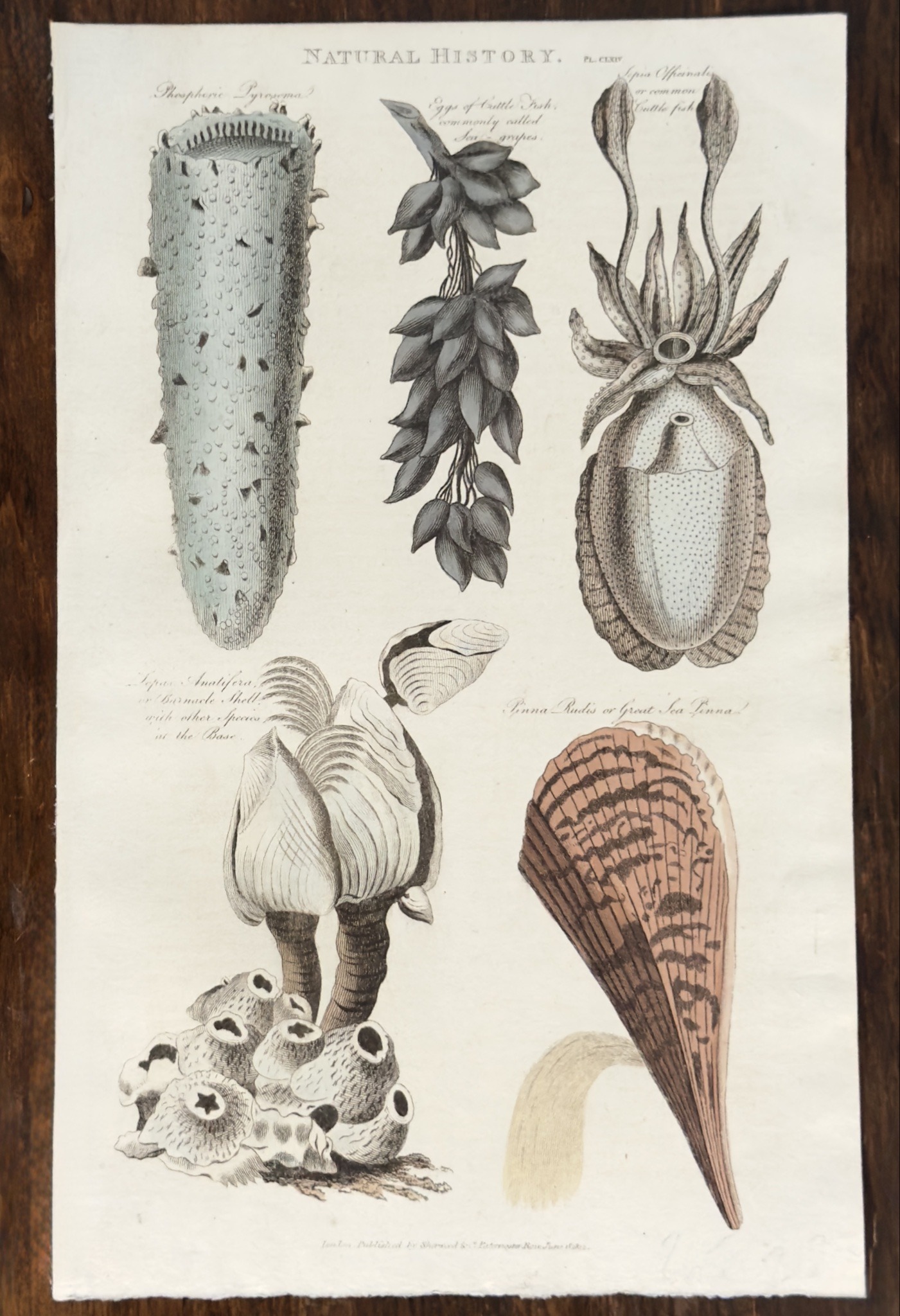
This item is an antique-style printed plate on paper, featuring five distinct marine specimens. The top of the page is titled 'NATURAL HISTORY' with 'Pl. CLXIV' in the upper right. Specimens are labeled with cursive text including 'Phosphoric Pyrosoma', 'Eggs of Cuttle Fish', 'Sepia Officinalis', 'Lepas Anatifera', and 'Pinna Rudis or Great Sea Pinna'. The print exhibits characteristics consistent with 19th-century steel or copper-plate engravings, featuring fine cross-hatching and delicate stippling to create volume. Subtle, possibly hand-applied washes of color in blue, brown, and grey tones enhance the illustrations. The paper shows signs of age-appropriate toning and minor foxing (small brown spots), particularly along the edges. A faint publisher's line at the bottom appears to read 'London Published by Sherwood & Co Paternoster Row', which is consistent with early to mid-1800s scientific publications. The craftsmanship is of high quality, demonstrating the detailed anatomical precision typical of Georgian or Victorian era zoological studies. Identification as a period-correct original remains a hypothesis pending physical inspection of paper weight, plate marks, and ink penetration.
AI Appraisal Report

·AI can make mistakes·Verify before acting
Based on my visual assessment of the digital image provided, this item appears to be a 19th-century natural history engraving depicting various marine specimens. The printing bears a publisher line consistent with Sherwood & Co. of London, suggesting a possible origin in the early to mid-18th century as part of a scientific compendium. From what I can see, the fine stippling and cross-hatching indicate a steel or copper-plate process typical of the Georgian or Victorian eras. However, I cannot verify the physical paper weight, the presence of an embossed plate mark, or the specific nature of the ink penetration via a photograph. These physical characteristics are necessary to differentiate a period-correct printing from a high-quality later fascimile. The value estimate of $125 - $225 is based on the hypothesis that this is a period-produced plate in good condition with minor foxing. Demand for natural history prints remains steady among collectors of 'Wunderkammer' style decor and scientific ephemera. The presence of hand-applied color typically increases desirability compared to monochrome versions. To confirm this valuation, an in-person examination is required to verify the paper's age and determine if the coloring is contemporary to the printing or added later. If further inspection reveals this to be a modern reproductive copy or a photolithographic 'in the style of' print, the market value would likely decrease to a nominal range of $15 - $30. Total valuation is contingent upon authentication of the production date and the medium's integrity, as unauthenticated decorative pieces generally sell for significantly less than verified antiquarian specimens.

Get your items appraised

Instant estimates of your treasures with AI-powered appraisals

Browse More Appraisals