These notes were written by the person who submitted this item. Appraiser.AI has not verified them, and the AI's identification and estimate may rely on them.
AI Estimated Value
Not an official valuation
$20-40
AI estimate as of June 16, 2025 · verify with a professional before acting
AI-Generated · Verify before acting
Everything on this page is generated by AI for informational purposes only. AI can make mistakes — the AI may misidentify items or misattribute them (artist, maker, brand, designer, origin, era). This is not an official valuation and should not be used for insurance, sale, tax, estate, legal, or lending purposes — or any decision requiring a certified appraisal. It is not an authoritative claim about any person, brand, or rights holder — do not share or rely on it as a factual statement about a third party. Always consult qualified professionals before making financial decisions.
This analysis also relies on unverified notes provided by the user, which may be incomplete or inaccurate and could affect the result.
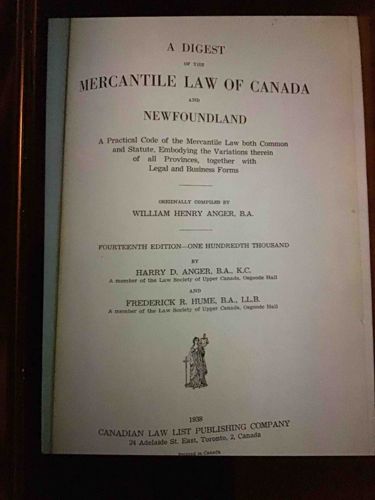
This item is a legal textbook titled "A Digest of the Mercantile Law of Canada and Newfoundland." The book is a fourteenth edition, described as the "ONE HUNDREDTH THOUSAND," indicating a significant printing run for its time. It is a practical code of mercantile law, covering both Common Law and Statute, and highlights variations across all Canadian provinces and Newfoundland. It also includes legal and business forms. The original compilation is by William Henry Anger, B.A., with this specific edition compiled by Harry D. Anger, B.A., K.C., and Frederick R. Hume, B.A., LL.B., both members of the Law Society of Upper Canada, Osgoode Hall. The cover is a light color, possibly off-white or light grey, and appears to be made of paper or cardstock. The text is printed in black ink in various font sizes, with the title being the largest and boldest. There is a small illustration of a robed figure holding a scale and a sword, positioned above the publication details. The publication year, 1938, is clearly visible below the illustration. The publisher is listed as the Canadian Law List Publishing Company, located at 24 Adelaide St. East, Toronto, 2 Canada, and it is noted as being "Printed in Canada." The book's overall appearance suggests it is in good condition with minimal visible wear or damage based on the provided image and the prompt's information. The binding and pages appear intact, and there are no obvious tears, significant stains, or missing sections. The paper shows some age-appropriate toning, but no major discoloration. The printing is clear and legible. The style is typical of legal and academic texts from the early 20th century.
AI Appraisal Report
I have examined the image of this 1938 edition of "A Digest of the Mercantile Law of Canada and Newfoundland." Based on the visual evidence, the book appears to be in good condition, consistent with the owner's description. The cover shows minimal wear, the spine appears solid, and the pages seem free from significant damage like tears or heavy staining. The clarity of the text and the visible details of the cover design and publication information all support its authenticity as a 1938 edition by the stated publisher. This was a widely printed legal reference for its time, indicated by the "ONE HUNDREDTH THOUSAND" note. While such legal texts can have some collector interest, particularly early or rare editions, this printing volume suggests it is not a rare item. Market demand for standard legal texts from this era is generally low unless they are historically significant for a specific reason or are signed/annotated by a notable figure, neither of which is indicated here. Comparable sales of similar, non-rare 20th-century Canadian legal texts in good condition typically fall within a modest range. The value is primarily as a historical legal reference, not a high-value collectible. For complete authentication, a physical examination would allow for tactile inspection of the paper quality, binding integrity, and confirmation of watermarks or publisher's marks not visible in the image. Provenance documentation, such as previous ownership records, could add value but is not essential for authenticating the edition itself based on published details.