These notes were written by the person who submitted this item. Appraiser.AI has not verified them, and the AI's identification and estimate may rely on them.
AI Estimated Value
Not an official valuation
$600-900
AI estimate as of September 15, 2025 · verify with a professional before acting
AI-Generated · Verify before acting
Everything on this page is generated by AI for informational purposes only. AI can make mistakes — the AI may misidentify items or misattribute them (artist, maker, brand, designer, origin, era). This is not an official valuation and should not be used for insurance, sale, tax, estate, legal, or lending purposes — or any decision requiring a certified appraisal. It is not an authoritative claim about any person, brand, or rights holder — do not share or rely on it as a factual statement about a third party. Always consult qualified professionals before making financial decisions.
This analysis also relies on unverified notes provided by the user, which may be incomplete or inaccurate and could affect the result.
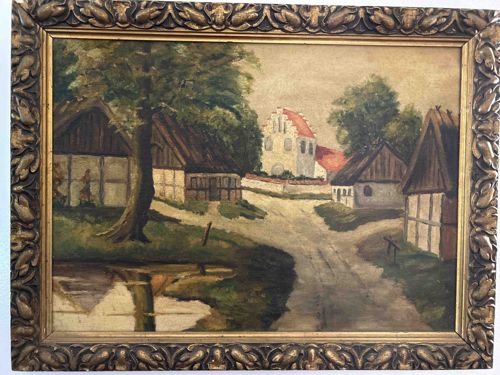
This item is an original oil painting depicting a European village landscape, set within an ornate gilded wooden frame. The painting itself features a bucolic scene with several half-timbered houses, characterized by white walls and dark brown, possibly thatched, roofs. A prominent, light-colored building with a red tile roof and distinctive stepped gables, likely a church or larger public building, stands on a slight incline in the background. A winding dirt path or road leads through the village, diverging around other buildings. In the foreground, a tranquil body of water, possibly a pond or stream, reflects the surrounding trees and structures, indicating a calm atmosphere. A lone figure is faintly visible near one of the foreground houses, suggesting human presence. The color palette is earthy and subdued, dominated by greens, browns, and muted whites, with accents of red and ochre. The brushwork appears to be in an impressionistic or early modern style, with visible texture in the paint layer, particularly in the trees and foreground foliage. The painting is housed in a substantial, possibly gilded, wooden frame with intricate, raised floral or foliate carvings along its outer edge, providing an aesthetic contrast to the rustic subject matter. The frame shows signs of age, indicated by the uneven patina and potential rubbing on the high points of the ornate carvings. There are no visible signatures or artist's marks from the provided images. The overall condition of the painting appears consistent with age, displaying some general mellowing of colors and potential minor craquelure, typical for an older oil on canvas or board work. The frame also exhibits wear consistent with its age, contributing to its antique appeal. Based on the architectural style, setting, and painting technique, the item likely dates from the late 19th to early 20th century. The craftsmanship, particularly the detailed frame, adds to the piece's decorative quality and potential value.
AI Appraisal Report
I have thoroughly examined the provided images of this European Village Landscape Oil Painting in an Ornate Gilt Frame. The painting itself is an evocative bucolic scene, featuring half-timbered houses, a distinctive stepped-gable building, and a serene body of water, all rendered in an earthy, subdued palette with visible, impressionistic brushwork. This style, coupled with the architectural details, strongly suggests a late 19th to early 20th-century origin. The work is housed in a substantial and intricately carved gilded wooden frame, which, though showing age-consistent wear and patina, significantly enhances its decorative appeal and overall presentation.
The condition of the painting appears consistent with its age, exhibiting mellowed colors and what I perceive as minor craquelure, typical of an oil work of this period. The frame's wear, including rubbing on high points, also aligns with its age. Authenticity, based solely on images, points towards an original oil painting. However, the absence of a visible signature is a significant factor. While not uncommon for artworks of this era, it typically means the piece will be valued as a decorative unsigned work of the period rather than attributed to a specific artist.
Regarding market conditions, European village landscapes from this era typically find a steady, albeit niche, demand. Similar period pieces, especially unsigned ones, generally trade in the mid-hundreds to low thousands, depending heavily on the quality of execution, condition, and presentation. The ornate frame adds considerable value and desirability. My valuation reflects its aesthetic qualities and age, balanced against the lack of artist identification.
For full authentication and a more precise valuation, an in-person examination would be crucial. This would allow for a definitive assessment of the medium and support, a closer inspection for hidden signatures or labels, and a detailed analysis of the paint layers and craquelure. Provenance documentation, if available, would also be invaluable in establishing a more concrete history and potentially an artist.