AI estimate as of December 1, 2025 · verify with a professional before acting
AI-Generated · Verify before acting
Everything on this page is generated by AI for informational purposes only. AI can make mistakes — the AI may misidentify items or misattribute them (artist, maker, brand, designer, origin, era). This is not an official valuation and should not be used for insurance, sale, tax, estate, legal, or lending purposes — or any decision requiring a certified appraisal. It is not an authoritative claim about any person, brand, or rights holder — do not share or rely on it as a factual statement about a third party. Always consult qualified professionals before making financial decisions.
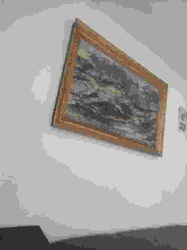
This item is a framed oil painting, likely executed on canvas or board, depicting two nude figures in a lush, dark green woodland or grotto setting. The overall palette is muted, with dominant earthy tones of brown, deep green, and warm skin tones, accented by reddish-brown hair on one figure. The composition features one figure, seemingly female with long reddish hair, reclined or semi-reclined horizontally and slightly elevated in the upper central portion of the painting. Her body appears to be draped or partially covered with a light, flowing fabric. Below her, another figure, possibly male, is similarly reclined on the ground, also partially draped with a reddish-brown cloth around the lower body. The brushwork appears loose and impressionistic, suggesting a focus on mood and atmosphere rather than sharp detail, typical of late 19th or early 20th-century artistic styles. The painting is housed within a simple, possibly wooden, rectangular frame with a warm, aged finish, exhibiting some wear and minor gesso loss on the edges, consistent with age. There are no visible artist's signatures or prominent manufacturing marks discernible from the image. The surface of the painting shows some signs of age, including potential surface grime or subtle craquelure, which is common in older oil paintings. The soft focus and low resolution of the image make precise identification of materials and extreme details challenging, but the overall impression is one of a classical, allegorical, or mythological subject rendered with an expressive hand. The quality of craftsmanship appears to be moderate to good, characteristic of a period hobbyist or a lesser-known academic artist.
AI Appraisal Report
I have examined the image provided for this oil painting depicting two reclining nudes in a woodland setting. The muted palette of earthy tones, deep greens, and warm skin tones, along with the loose, impressionistic brushwork, suggests a late 19th or early 20th-century style. The composition, featuring draped figures, hints at a classical, allegorical, or mythological subject.
From the image, the painting appears to be in fair condition. I observe signs of age, including potential surface grime and subtle craquelure, which are typical for oil paintings of this age. The simple wooden frame shows some wear and minor gesso loss, consistent with its likely vintage. The craftsmanship appears moderate, suggesting the work of a hobbyist or a lesser-known academic artist of the period rather than a master.
Market conditions for unsigned works of this nature, particularly those by unknown artists, tend to be modest. While classical nudes can be appealing, the lack of a prominent artist or significant historical context limits its value. Demand is generally low to moderate for such pieces, and rarity is not a significant factor without unique identifying characteristics or provenance. Comparable sales for similar unsigned period works in fair condition typically fall within the low hundreds.
Without a signature, definitive authentication is impossible from an image alone. The most significant factor impacting value is the absence of an identifiable artist. For full authentication and a more precise appraisal, an in-person examination would be crucial to assess the true condition, verify the medium and age, and search for faint or hidden signatures. Additionally, provenance documentation, if available, would significantly enhance its value. Scientific testing, such as pigment analysis, could confirm its age and materials.