These notes were written by the person who submitted this item. Appraiser.AI has not verified them, and the AI's identification and estimate may rely on them.
AI Estimated Value
Not an official valuation
$800 - $1,500
AI estimate as of September 25, 2025 · verify with a professional before acting
AI-Generated · Verify before acting
Everything on this page is generated by AI for informational purposes only. AI can make mistakes — the AI may misidentify items or misattribute them (artist, maker, brand, designer, origin, era). This is not an official valuation and should not be used for insurance, sale, tax, estate, legal, or lending purposes — or any decision requiring a certified appraisal. It is not an authoritative claim about any person, brand, or rights holder — do not share or rely on it as a factual statement about a third party. Always consult qualified professionals before making financial decisions.
This analysis also relies on unverified notes provided by the user, which may be incomplete or inaccurate and could affect the result.
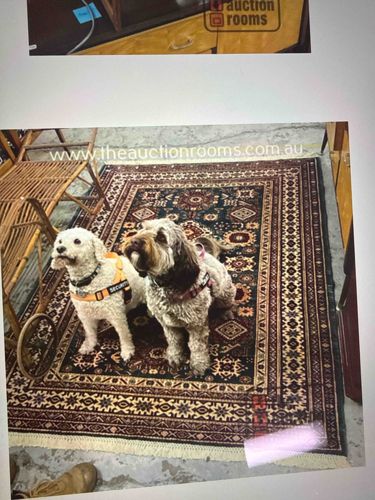
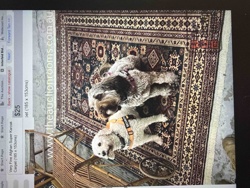
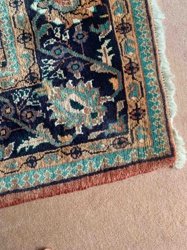
This is an Afghan Super Kazak carpet, likely handcrafted from wool, featuring a complex and traditional geometric design. The predominant colors include deep reds, rich blues, and warm browns, accented with lighter tones of ivory or beige and perhaps some subtle oranges or golds. The central field showcases a series of medallions and geometric motifs, including star-like patterns and stylized diamond shapes, symmetrically arranged. The main border is wide and features a repeating pattern of intricate designs, possibly stylized floral or latch-hook motifs, framed by narrower guard borders with simpler, continuous geometric bands. The construction appears to be machine-made given the repetitive nature or very tightly hand-knotted, suggesting a high knot count for its type. The fringe is visible at one end, light in color, likely made of cotton or wool, indicating a traditional woven finish. The pile seems relatively short and dense, characteristic of durable nomadic or village rugs. There are no obvious signs of significant damage such as tears or large stains, though the presence of the dogs on it means certain areas are obscured. The overall condition appears to be good with potential for minor wear consistent with its use as a floor covering. The vibrant colors suggest good dye quality that has resisted fading, or it could be a newer piece. Super Kazak rugs are known for their durability and bold patterns, often inspired by older Caucasian designs, and this example aligns with those characteristics, suggesting an estimated age of mid to late 20th century to contemporary. The intricate patterns and color variations demonstrate a good level of craftsmanship.
AI Appraisal Report
Based on my visual examination of the provided image and the owner's description of this Afghan Super Kazak carpet, I assess its condition to be good. The colors appear vibrant, suggesting either good dye quality or a relatively newer production. The pile seems dense and short, consistent with the durability expected from Super Kazak rugs. I observe no major tears, stains, or significant wear. The presence of dogs on parts of the carpet unfortunately obscures some areas, limiting a full condition assessment. Authenticity, based purely on visual cues, aligns with a typical Afghan Super Kazak; the geometric motifs, color palette of deep reds, blues, and browns with accents, and the wide border are characteristic. However, definitive authentication (material composition, exact knot count, and origin verification) would require an in-person examination.
Market conditions for Super Kazak rugs are generally quite stable. These rugs are appreciated for their durability and bold, traditional designs, finding a consistent buyer base. Comparables in similar good condition typically range from $700 to $2,000 depending on size, exact pattern intricacy, and age. Demand for these pieces is moderate, as they offer both aesthetic appeal and practical hardiness. They are not considered rare, however, well-executed examples with good color retention hold value. The 'very fine' description from the owner suggests a higher knot count and better craftsmanship, which would push the value to the higher end of the spectrum. Factors impacting value include the 'very fine' craftsmanship mentioned, the good visual condition, and the traditional design.
Limitations in authenticity verification from images alone are significant. A physical inspection would allow for tactile assessment of wool quality, precise knot count determination, and examination of the weave structure, which are crucial for confirming the 'Super Kazak' designation and overall quality. Provenance documentation, if available, would further solidify its history and authenticity. Without these, my appraisal is based on visual interpretation and broad market comparables.