AI estimate as of August 16, 2025 · verify with a professional before acting
AI-Generated · Verify before acting
Everything on this page is generated by AI for informational purposes only. AI can make mistakes — the AI may misidentify items or misattribute them (artist, maker, brand, designer, origin, era). This is not an official valuation and should not be used for insurance, sale, tax, estate, legal, or lending purposes — or any decision requiring a certified appraisal. It is not an authoritative claim about any person, brand, or rights holder — do not share or rely on it as a factual statement about a third party. Always consult qualified professionals before making financial decisions.
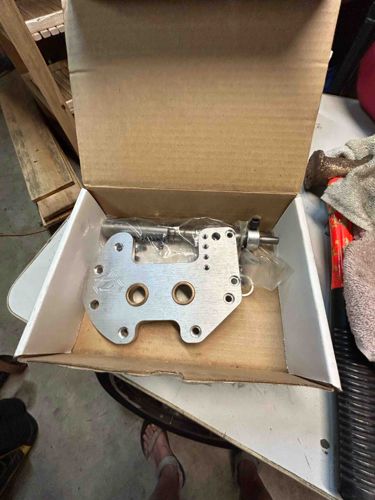
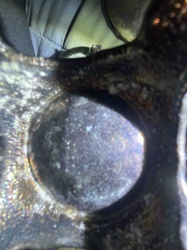
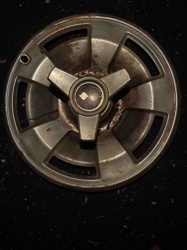
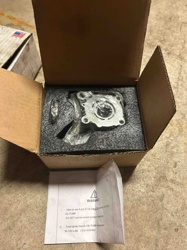
The item appears to be a new or meticulously maintained automotive performance part, likely an aftermarket oil pump or related lubrication system component, specifically designed for a high-performance engine application. It is constructed primarily from what appears to be machined aluminum alloy, presenting a clean, bright, brushed metallic finish, indicative of precision manufacturing. The main plate is irregularly shaped with multiple precisely drilled and counter-sunk holes around its perimeter for mounting purposes, suggesting a custom or application-specific fitment. Two prominent circular openings, fitted with what appear to be bronze bushings or inserts, are visible on the main body, likely serving as bearing surfaces for shafts or gears. There are also several smaller drilled passages and precise machining cuts on the surface, typical for fluid flow or mounting internal components. A shaft, possibly part of a pump assembly, is protruding from one side, partially encased in a clear plastic bag, hinting at new-in-box condition. Another component, possibly a gear or cam, is attached to the end of this shaft. The overall construction exhibits high-quality milling and a clean, unblemished surface, suggesting excellent craftsmanship. There are no visible signs of wear, damage, oxidation, or repair, confirming its new or near-new condition. The presence of packaging (cardboard box) further supports it being a new, unused item. While no specific maker's marks or part numbers are clearly discernible in the image, the typical design and precision suggest it's a component for internal combustion engines, likely for racing or highly modified street vehicles, where enhanced lubrication flow or pressure is critical. Its style is purely functional and performance-oriented, characteristic of modern aftermarket automotive engineering.
AI Appraisal Report
Upon visual examination of the provided image, this aftermarket engine oil pump assembly component appears to be in new or near-new condition. The machined aluminum alloy exhibits a clean, bright, brushed finish with no discernible signs of wear, damage, or oxidation. The precision of the machining, including the multiple drilled and counter-sunk holes, circular openings with bronze inserts, and various passages, indicates high-quality manufacturing. The partial plastic bagging on the protruding shaft further supports its new, unused state. This suggests it's a performance-oriented component likely for high-end automotive applications such as racing or heavily modified street vehicles, where enhanced lubrication is critical.
Market comparables for high-performance aftermarket oil pumps vary widely based on the specific engine application (e.g., LS, Coyote, Honda K/B series) and brand reputation. Premium aftermarket oil pumps from reputable manufacturers like Melling, Moroso, Peterson Fluid Systems, or Titan Motorsports can range from $400 for a basic upgraded pump to well over $1,500-$2,000 for dry sump pump systems or highly specialized, billet designs. The lack of visible maker's marks or part numbers prevents direct comparison, which is a significant limiting factor. Demand for such components is generally steady within the enthusiast and racing communities, as they are essential upgrades for increased engine reliability and performance.
Factors significantly impacting value include the specific engine application (which determines market size and demand), the manufacturer's reputation, and the pump's flow/pressure capabilities. Without this information, a precise valuation is challenging. The rarity is difficult to ascertain visually but typically, highly specialized performance parts are not mass-produced, contributing to their value.
Limitations in authenticity verification from an image alone are substantial. While the visual quality suggests authenticity, I cannot confirm the material composition, internal tolerances, or functionality. For full authentication, I would require a physical in-person examination to inspect internal components, check for manufacturing marks, and verify precision with measuring tools. Provenance documentation (receipts, manufacturer certificates) would be crucial to confirm its origin and new condition. Scientific testing might be needed to verify alloy composition if there were any doubts about material quality. Without these, the appraisal is based solely on apparent visual quality and market trends for similar, but not identical, items.