AI estimate as of October 26, 2025 · verify with a professional before acting
AI-Generated · Verify before acting
Everything on this page is generated by AI for informational purposes only. AI can make mistakes — the AI may misidentify items or misattribute them (artist, maker, brand, designer, origin, era). This is not an official valuation and should not be used for insurance, sale, tax, estate, legal, or lending purposes — or any decision requiring a certified appraisal. It is not an authoritative claim about any person, brand, or rights holder — do not share or rely on it as a factual statement about a third party. Always consult qualified professionals before making financial decisions.
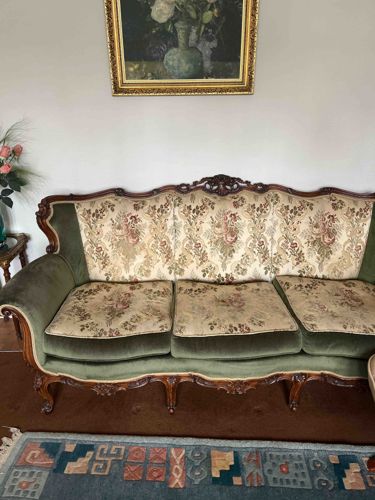
This is a large, three-seater sofa, likely dating from the mid to late 20th century, styled to emulate Victorian or Rococo Revival furniture. The sofa features an elaborately carved wooden frame, visible along the top of the backrest, the armrests, and the apron below the seat. The wood appears to be a dark stained hardwood, possibly mahogany or walnut, exhibiting a rich, deep brown hue. The carving is intricate, featuring floral and scroll motifs, particularly prominent on the crest rail of the back and on the cabriole legs. The upholstery consists of two distinct fabrics: a dark olive green velvet or velour for the arms, seat base, and seat cushions, and a lighter, patterned fabric for the backrest and the top layer of the seat cushions. The patterned fabric is a tapestry or needlepoint style, featuring floral bouquets in shades of rose, cream, and muted green on a beige or light gold background. The sofa has three individual seat cushions and a continuous backrest that is tufted vertically, creating three distinct sections mirroring the seat cushions. The overall condition appears to be good for its age, though some wear and slight compression of the velvet upholstery may be present, as well as potential fading or minor discoloration on the patterned fabric. The exposed wooden elements show a glossy finish, and there are no immediately visible major damages such as cracks or breaks in the wood, or significant tears in the upholstery, from the provided image. The craftsmanship suggests a commercially produced piece designed to evoke historical opulence. Unique aspects include the combination of two upholstery fabrics and the distinctive carving along the base and top, typical of ornate historical styles.
AI Appraisal Report
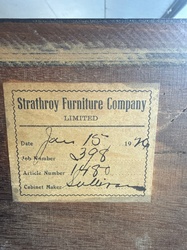
Based on my visual examination of the provided image, this Victorian Style Carved Wood and Upholstered Sofa appears to be a mid-to-late 20th-century production, emulating Rococo Revival or Victorian aesthetics. The elaborate carving, dark hardwood (likely mahogany or walnut), and distinctive dual-fabric upholstery strongly suggest a commercially produced piece designed to evoke historical grandeur, rather than an authentic 19th-century antique. Authenticity as a true antique cannot be definitively confirmed without in-person inspection, which would involve examining joinery, wood grain, and upholstery materials more closely, as well as searching for manufacturer marks. Provenance documentation would also be crucial.
Condition appears good for its age, showing some expected wear such as slight velvet compression consistent with use, but no immediately visible major damage like breaks in the wood or significant tears in the upholstery. The glossy finish on the wood is well-maintained.
Market conditions for revival pieces like this are moderate. While the ornate style has a niche appeal, these items generally do not command the same prices as genuine antiques. Comparables frequently show similar sofas selling in the $700-$1,200 range, depending on condition and specific design elements. Demand is stable among collectors of traditional furnishings. The combination of two distinct upholstery fabrics, particularly the patterned tapestry, is a unique factor that adds to its decorative appeal, but also might limit broader appeal if the pattern is not to a specific buyer's taste. The lack of provenance documentation, which is common for 20th-century decorative pieces unless it's a known designer piece, impacts its investment value compared to an documented antique. In-person examination would verify wood type, actual fabric condition, and confirm structural integrity.