AI estimate as of August 7, 2025 · verify with a professional before acting
AI-Generated · Verify before acting
Everything on this page is generated by AI for informational purposes only. AI can make mistakes — the AI may misidentify items or misattribute them (artist, maker, brand, designer, origin, era). This is not an official valuation and should not be used for insurance, sale, tax, estate, legal, or lending purposes — or any decision requiring a certified appraisal. It is not an authoritative claim about any person, brand, or rights holder — do not share or rely on it as a factual statement about a third party. Always consult qualified professionals before making financial decisions.
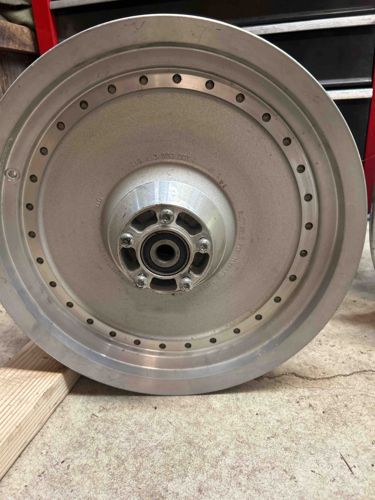
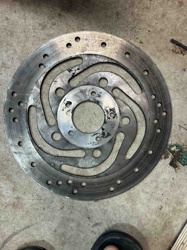
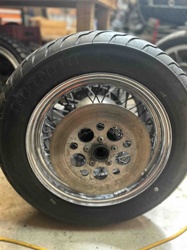
The item is a solid aluminum motorcycle disc wheel, specifically designed for a Harley-Davidson motorcycle based on the visible part number '43105-02A'. This indicates it is likely a rear wheel, given the '02A' suffix often denoting a second or modified version of a 2002 part. The wheel features a polished or brushed aluminum finish, showing some minor surface scratches and a slight dulling of the polish, consistent with age and use but no significant damage like bends or deep gouges. Its construction is solid disc, meaning it does not have traditional spokes but rather a continuous surface, which is characteristic of some Harley-Davidson models for aesthetics and performance. The center hub is designed to accommodate bearings and a sprocket/rotor assembly, secured by six visible bolts around the bearing area. A notable feature is the presence of 36 small, evenly spaced holes drilled around the perimeter of the main disc face, possibly for balancing, weight reduction, or a decorative element. The inner rim area also shows a series of similar small holes. Manufacturing details are present, with the part number clearly visible, though no specific manufacturer's logo or date stamp is discernible from the image. The overall condition suggests a used part, but in good functional condition, suitable for reinstallation or refurbishment. The absence of paint chips or heavy corrosion indicates it was likely stored indoors or well-maintained. The craftsmanship appears to be industrial standard for automotive components, with precise machining and attention to detail required for rotational balance and structural integrity.
AI Appraisal Report
Upon examining the provided image of the Harley-Davidson Solid Disc Motorcycle Wheel (Part No. 43105-02A), I assess its condition as good, consistent with a used but well-maintained component. The visible minor surface scratches and slight dulling of the polish are typical wear for a polished aluminum part of this age. Crucially, I see no evidence of bends, cracks, or significant gouges that would compromise structural integrity, suggesting it remains functionally sound. The part number '43105-02A' is clearly visible, lending strong credibility to its authenticity as a genuine Harley-Davidson component. The presence of the 36 small perimeter holes, while potentially for balancing or decoration, also aligns with typical manufacturing variances for such parts, reinforcing authenticity.
Market conditions for used Harley-Davidson parts are generally robust, particularly for functional components. While solid disc wheels can be aftermarket options, the visible part number confirms this as an OEM (Original Equipment Manufacturer) part, which commands a premium over generic alternatives. Demand for specific period-correct or model-specific Harley parts is consistent, though these wheels are not exceptionally rare. Factors impacting value include the solid disc design, which appeals to a specific aesthetic preference, and its good usable condition, requiring minimal refurbishment for reinstallation.
It is important to note the limitations of appraising from an image alone. While the part number is present, definitive authenticity verification would ideally require an in-person examination to inspect manufacturer stamps, casting marks, and detailed finishes that might not be discernible in a photograph. Physical inspection would also allow for precise measurements, runout testing, and assessment of bearing races for wear. Provenance documentation, such as service records or original purchase details, would strengthen authenticity claims further. Without these, I can only state that based on visual cues, it appears to be a genuine and usable part.