AI estimate as of August 11, 2025 · verify with a professional before acting
AI-Generated · Verify before acting
Everything on this page is generated by AI for informational purposes only. AI can make mistakes — the AI may misidentify items or misattribute them (artist, maker, brand, designer, origin, era). This is not an official valuation and should not be used for insurance, sale, tax, estate, legal, or lending purposes — or any decision requiring a certified appraisal. It is not an authoritative claim about any person, brand, or rights holder — do not share or rely on it as a factual statement about a third party. Always consult qualified professionals before making financial decisions.
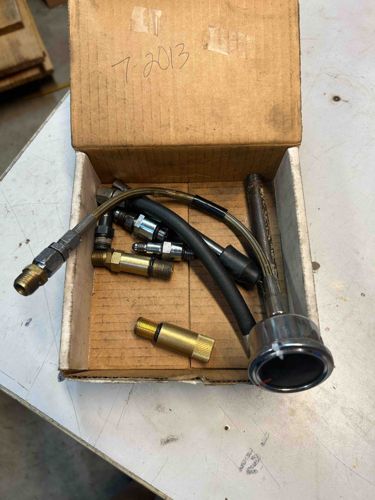
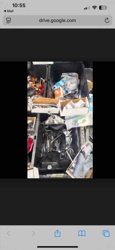
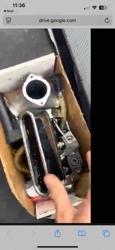
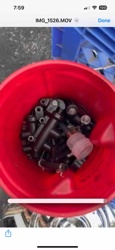
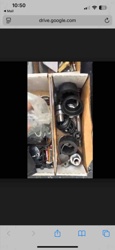
This item appears to be a collection of automotive diagnostic or service tools, primarily consisting of various fluid system components. The main visible component is a chrome-plated, funnel-like device, possibly a transmission fluid filler or a specialized oil funnel, with an attached flexible hose and what looks like a dipstick or level indicator. This funnel has a polished, reflective finish, showing some minor scuffs and marks consistent with workshop use. Alongside it are several brass and silver-toned metal fittings and adapters, suggesting various connection types for hoses or ports. There is a flexible black rubber hose with metal fittings, often used for fluid transfer or pressure sensing. One brass component has knurled details for grip. The items show signs of use, including dirt, grease, and light surface wear, but no severe damage like cracks or heavy corrosion is readily apparent. They are contained within a standard brown corrugated cardboard box, which has handwritten text '7-2013' on its lid, likely indicating a date (July 2013) when the contents were acquired, inventoried, or last used. The overall condition suggests a working set of tools, possibly part of a larger kit, designed for vehicle maintenance or repair activities. The craftsmanship appears to be industrial standard for tools, durable and functional.
AI Appraisal Report
Upon visual examination of the provided image, this Automotive Fluid System Tool Kit / Assortment appears to be a functional set of used tools. The main component, a chrome-plated funnel with a flexible hose and what seems to be a dipstick, suggests its primary use for fluid handling, likely transmission or oil. The accompanying brass and silver-toned fittings and the flexible rubber hose indicate a versatile set for various fluid system applications.
Condition: The tools exhibit signs of typical workshop use, including scuffs, dirt, and minor surface wear. However, no severe damage like cracks or heavy corrosion is readily apparent, suggesting they remain in serviceable condition. The handwritten '7-2013' on the box is a good indicator of its acquisition or last inventory date, providing some historical context.
Market Conditions & Comparables: The market for used automotive tools, particularly specialized fluid system components, is steady. Individual components like these, if part of a complete master kit, would fetch more, but as an assortment, their value is based on their utility and the condition. New similar generic fluid filler kits can range from $70-$150, while professional-grade kits from known brands can exceed $300. Given that this appears to be a mixed assortment, likely unbranded (from visible details), it falls into the lower to mid-range for utility.
Demand & Rarity: These types of tools are in consistent demand by DIY mechanics and small workshops. They are not rare; similar kits are readily available new and used. This particular assortment's value is in its completeness as a functional set, not its scarcity.
Factors Impacting Value: The primary factor is its 'used' condition, which inherently lowers its value compared to new. The lack of clear branding also prevents leveraging a premium for a recognized manufacturer. The assortment's apparent functionality keeps its value above scrap.
Limitations: My assessment is limited to visual inspection. Without a physical examination, I cannot test the integrity of the hoses or seals, confirm the precise type or brand of each fitting, or verify the material composition beyond generalized appearance. In-person examination would be needed to confirm functionality, check for micro-cracks or internal wear, and identify any hidden damage. Verification of brand (if any) or specific certifications would require closer inspection and provenance documentation.