AI Appraisal Estimate

AI-generated estimates · not official valuations

From the user

What was submitted

Photo and notes provided by the user — not generated by AI

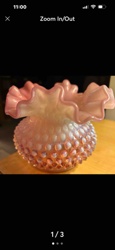
Submitted item photo
Submitted photo · May 27, 2026

User's notes

I’m in in

AI analysis below

AI appraisal

AI analysis & estimate

AI-Generated · Verify before acting

Everything below is generated by AI for informational purposes only. AI can make mistakes — the AI may misidentify items or misattribute them (artist, maker, brand, designer, origin, era). This is not an official valuation and should not be used for insurance, sale, tax, estate, legal, or lending purposes — or any decision requiring a certified appraisal. It is not an authoritative claim about any person, brand, or rights holder — do not share or rely on it as a factual statement about a third party. Always consult qualified professionals before making financial decisions.

Note

This analysis also relies on unverified notes provided by the user, which may be incomplete or inaccurate and could affect the result.

Read the full disclaimer

AI Identification

·Not independently authenticated·Verify before acting

Hand-Painted Enamel Three-Footed Glass Vase

Vintage Glassware & Decorative Arts

AI Estimated Value

·Not an official valuation·Verify before acting

$45.00 - $65.00

As of May 27, 2026

AI Item Analysis

·AI can make mistakes·Verify before acting
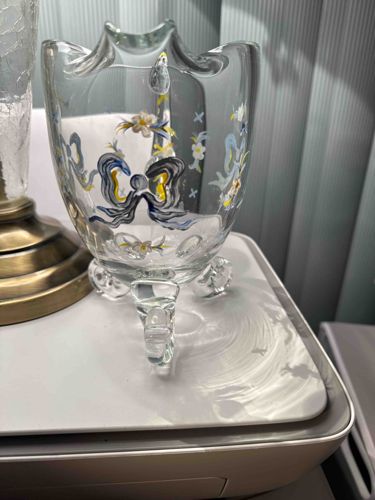
This small clear glass vessel features a distinctive three-footed base and a scalloped or ruffled top rim. The piece is constructed from mold-blown or pressed transparent glass with applied, hand-painted enamel decorations. The primary motif consists of decorative blue and yellow ribbons or bows, interspersed with delicate white floral accents and small blue cross-hatch or star-shaped symbols. The colors used are primarily cobalt blue, white, and a pale buttery yellow. The three feet are molded as integrated glass extensions with a curved, shell-like or scroll-like profile, providing stability. In terms of condition, the glass appears to be in good vintage state without major fractures or chips visible, though there is slight thinning and wear to the enamel paint, particularly around the edges of the ribbon motifs, which is consistent with age and handling. This style is reminiscent of mid-20th-century decorative glassware, possibly of European origin or produced by American companies such as Fenton or Tiffin during the 1940s-1950s. The hand-painted nature of the bows indicates a level of artisanal craftsmanship often found in giftware from this period. No distinct maker's marks are visible in the photograph, but the clarity of the glass and the precision of the ruffled rim suggest professional manufacturing quality.
AI Appraisal Report

·AI can make mistakes·Verify before acting
Based on my examination of this hand-painted enamel three-footed glass vessel, I find it to be a charming example of mid-20th-century decorative giftware. The piece displays characteristic features of American or European glass production from the 1940s-1950s, such as the ruffled rim and mold-blown construction. The enamel application of blue and yellow ribbons, while displaying minor wear consistent with its age, maintains good color saturation and indicates a higher level of artisanal care than mass-market decal alternatives. The glass clarity is excellent, and the three-footed scroll base is intact without the usual micro-chipping seen in similar utilitarian art glass. The current market for mid-century decorative glass is stable, though non-signed pieces like this one occupy a secondary tier compared to documented works by Fenton or Tiffin. Similar hand-painted tri-footed bowls typically realize prices in the $40 to $70 range at specialty antique auctions. The value is primarily driven by the 'cottagecore' aesthetic and the excellent condition of the delicate ruffled rim. A primary limitation of this appraisal is the absence of a maker's mark; while the quality suggests professional manufacturing, I cannot definitively attribute it to a specific glasshouse without provenance documentation or a catalog match. Physical inspection would be required to rule out modern reproductions by checking for authentic bottom wear and tactile enamel thickness. For a full authentication, I would recommend checking for any acid-etched signatures near the base or cross-referencing the specific bow pattern against historical company line drawings from the 1940s.

Get your items appraised

Instant estimates of your treasures with AI-powered appraisals

Browse More Appraisals