AI estimate as of November 9, 2025 · verify with a professional before acting
AI-Generated · Verify before acting
Everything on this page is generated by AI for informational purposes only. AI can make mistakes — the AI may misidentify items or misattribute them (artist, maker, brand, designer, origin, era). This is not an official valuation and should not be used for insurance, sale, tax, estate, legal, or lending purposes — or any decision requiring a certified appraisal. It is not an authoritative claim about any person, brand, or rights holder — do not share or rely on it as a factual statement about a third party. Always consult qualified professionals before making financial decisions.
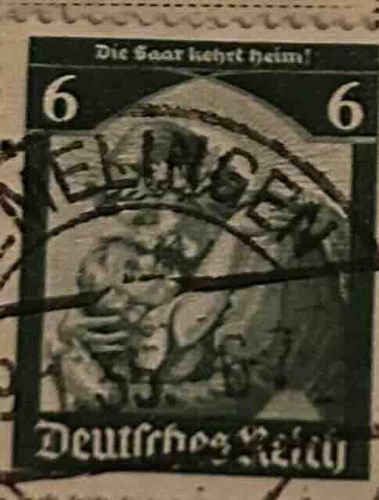
This is a German postage stamp from the Third Reich era, commemorating the return of the Saar region to Germany. The stamp is a rectangular form, with visible perforations along its edges, indicating it was torn from a sheet. The primary colors appear to be dark grey or black for the border and text, with a lighter grey or off-white for the central illustration. The design features a stylized image of a man and a child, possibly representing a father welcoming his child home, symbolizing the Saar's reintegration. The man's arm appears to be around the child, and they are centrally placed within a rounded arch or gateway. The top border of the stamp clearly reads 'Die Saar kehrt heim!' which translates to 'The Saar returns home!', a phrase indicative of the political event it commemorates. The denomination '6' is prominently displayed in both upper corners. The bottom border features the text 'Deutsches Reich' in an old German script, confirming its origin. A distinctive feature is the heavy, circular postmark or cancellation mark, partially obscuring the central image. This cancellation mark has text that includes what appears to be 'KEL...EN 193.' The numbers '193' are visible, suggesting the year of cancellation, possibly 1935, which aligns with the historical event. The stamp appears to be in used condition due to the postmark, and some light wear or discoloration might be present, consistent with its age. The print quality appears standard for postage stamps of the period.
AI Appraisal Report
This Third Reich 'Saar Returns Home' commemorative stamp, Scott #B74, appears to be authentic based on the visual characteristics aligning with known examples of this issue. The design elements, text, and numerical denomination are consistent with the official release. The heavy circular postmark, partially obscuring the central image, confirms it as a used example. While the postmark date '193.' suggests 1935, which corresponds to the Saar plebiscite and return, the full legibility helps in determining its exact cancellation. The perforations are visible, and the overall print quality appears standard for the period.
In terms of condition, the significant cancellation mark detracts from the aesthetic appeal, and any light wear or discoloration, typical for a stamp of this age, would further influence its grade. Without physical inspection, I cannot confirm exact paper quality, presence of hidden faults, or precise perforation health. These factors, along with gum condition if it were unused, are crucial for a definitive condition assessment.
Market conditions for common Third Reich issues, especially used ones like this, are generally stable but not exceptionally strong. This particular stamp is not considered rare. Numerous examples exist in various conditions. Comparables show used copies typically trade in the low single to double-digit dollar range. Demand is moderate, primarily from collectors specializing in German stamps or WWII-era philately.
The presence of the heavy postmark is the most significant factor affecting its value, generally reducing it compared to a lightly hinged or unused example. For full authentication and a precise condition grade, a physical examination would be necessary to assess paper and gum integrity, scrutinize the cancellation for any forgeries, and thoroughly check for hidden flaws not visible in the image.