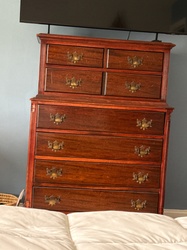
These notes were written by the person who submitted this item. Appraiser.AI has not verified them, and the AI's identification and estimate may rely on them.
AI Estimated Value
Not an official valuation
$100-200
AI estimate as of October 28, 2025 · verify with a professional before acting
AI-Generated · Verify before acting
Everything on this page is generated by AI for informational purposes only. AI can make mistakes — the AI may misidentify items or misattribute them (artist, maker, brand, designer, origin, era). This is not an official valuation and should not be used for insurance, sale, tax, estate, legal, or lending purposes — or any decision requiring a certified appraisal. It is not an authoritative claim about any person, brand, or rights holder — do not share or rely on it as a factual statement about a third party. Always consult qualified professionals before making financial decisions.
This analysis also relies on unverified notes provided by the user, which may be incomplete or inaccurate and could affect the result.
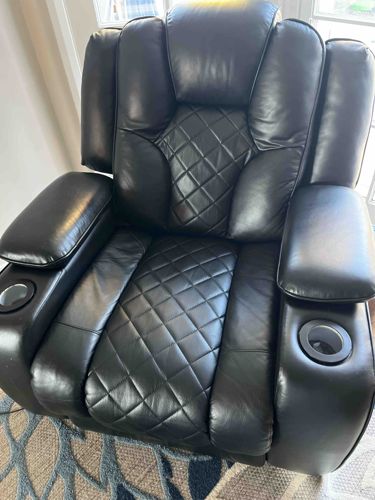
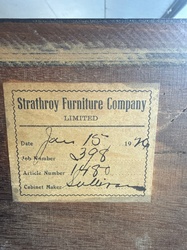
This is a single home theater-style recliner chair, upholstered in a glossy black faux leather material. The chair features a multipanel design with distinct padded sections for the headrest, upper back, lower back, seat, and leg rest, suggesting a high degree of ergonomic support. The central portion of the backrest and the seat cushion are adorned with a diamond-tufted pattern, created by stitching that forms a grid of raised diamond shapes, adding a touch of sophisticated detailing. The armrests are wide and well-padded, providing comfort, and each incorporates a recessed circular cupholder, finished with a metallic or dark plastic ring. The faux leather exhibits a slight sheen, indicative of its synthetic nature, and appears to be in good overall condition with some minor creasing and subtle wear visible around the edges of the cushions and armrests, consistent with regular use. No significant tears, scuffs, or repairs are immediately apparent. The construction appears sturdy, suggesting a modern manufacturing process, likely from the late 20th or early 21st century. The chair's design emphasizes comfort and utility, making it suitable for a home theater, living room, or media room setting. No visible maker's marks or signatures are discernible from the provided images.
AI Appraisal Report
I have examined the provided image and description of this black faux leather home theater recliner chair. Visually, the chair presents a multipanel design with significant padding, including a diamond-tufted pattern on the backrest and seat, which adds a decorative touch. Integrated cupholders enhance its home theater functionality. The faux leather exhibits a slight sheen, typical of synthetic upholstery. The overall condition appears good, with minor creasing and subtle wear visible, consistent with regular use but without significant damage. Authenticity for this type of modern manufactured furniture is primarily a matter of confirming it matches the description; there are no authenticity concerns in terms of historical significance or a specific maker without discernible marks.
Market conditions for used faux leather recliner chairs, especially those without a renowned brand, are highly competitive. Comparable new chairs in this style typically retail for $250-$500, but depreciation for used furniture, particularly faux leather, is steep. Demand for individual used recliners is moderate, often driven by budget-conscious consumers. The item's ubiquity and lack of rarity mean it does not command a premium. Factors impacting value include the faux leather material, which is less durable and desirable than genuine leather, and the visible signs of wear, however minor. No maker's marks are visible, preventing attribution to a specific brand that might influence value.
Limitations in authenticity verification from images alone include the inability to fully assess material quality, structural integrity, and the extent of wear and tear. A physical inspection would allow me to test the reclining mechanism, assess the comfort and firmness of the padding, feel the quality of the faux leather, and examine all surfaces for hidden damage, scuffs, or repairs. Provenance documentation or scientific testing are not typically relevant for this type of item, as its value is not tied to historical or artistic significance.