AI estimate as of September 28, 2025 · verify with a professional before acting
AI-Generated · Verify before acting
Everything on this page is generated by AI for informational purposes only. AI can make mistakes — the AI may misidentify items or misattribute them (artist, maker, brand, designer, origin, era). This is not an official valuation and should not be used for insurance, sale, tax, estate, legal, or lending purposes — or any decision requiring a certified appraisal. It is not an authoritative claim about any person, brand, or rights holder — do not share or rely on it as a factual statement about a third party. Always consult qualified professionals before making financial decisions.
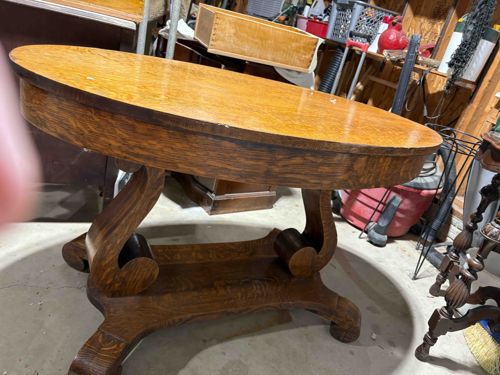
This is an oval-shaped dining or parlor table crafted from oak wood, likely quartersawn oak given the prominent ray fleck visible in the grain, particularly on the apron and base. The table features a substantial oval top with a visible wood grain and a relatively thick apron. The finish on the tabletop appears to be a clear varnish or lacquer, showing some wear and minor scratches consistent with use, with a slightly darker, more aged patina on the underside of the top and the base. The most distinguishing feature is its elaborately carved pedestal base, composed of two substantial scrolled or S-curved supports, which originate from a central column or base structure (not fully visible) and gracefully transition into a wide, X-shaped or cross-form base with scrolled feet. Each scroll on the base is deeply carved, showcasing the craftsmanship. There is a lower shelf or stretcher connecting the two main scrolled supports, adorned with cylindrical or spindle-like elements at its ends, adding to the decorative appeal and structural stability. The overall style suggests an antique or vintage piece, possibly late 19th or early 20th century, consistent with the Arts and Crafts or Mission Revival periods, known for their emphasis on oak furniture and visible joinery. There are no obvious major structural damages, but typical age-related wear, such as finish loss, minor dents, and scuffs, can be observed. The construction appears solid and well-made, indicative of quality furniture manufacturing from its era.
AI Appraisal Report
Based on my visual examination of the provided image, this Oval Oak Pedestal Dining Table is a delightful example of probable late 19th to early 20th-century craftsmanship. The prominent ray fleck, particularly visible on the apron and base, strongly suggests quartersawn oak, a desirable characteristic of the Arts and Crafts or Mission Revival periods. The substantial oval top and elaborately carved pedestal base, featuring S-curved supports and a cross-form base with scrolled feet, are hallmarks of this era. The presence of a lower stretcher with spindle-like elements further enhances its decorative and structural integrity.
In terms of condition, the table exhibits typical age-related wear, including some finish wear, minor scratches, and scuffs on the tabletop, consistent with a piece that has been regularly used over many decades. The darker, aged patina on the underside and base adds to its authenticity. Structurally, it appears solid, without any obvious major damages, which is a significant factor in maintaining its value.
Market conditions for antique oak furniture, especially functional pieces like dining tables, remain relatively stable. Demand is driven by collectors and individuals seeking period-specific or well-built, character-rich furniture. While not exceedingly rare, a table of this design and apparent quality is uncommon enough to attract interest.
Factors significantly impacting its value include its solid oak construction, intricate carving, and good overall structural integrity. The visual appeal and period correctness also contribute positively. The wear, while present, is commensurate with age and use, not detracting significantly from its appeal.
My assessment of authenticity is based solely on visual cues from the image. To fully authenticate the piece and provide a more precise valuation, an in-person examination would be crucial. This would allow for a detailed inspection of joinery, wood species confirmation, assessment of the original finish versus any alterations, and a thorough check for any hidden repairs or structural weaknesses that cannot be ascertained from a photograph. Provenance documentation, such as original sales receipts or family history, would also be invaluable for definitive authentication and potentially increasing its value.