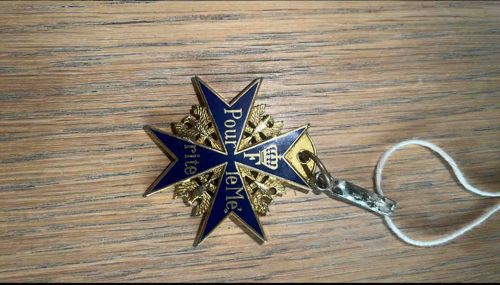
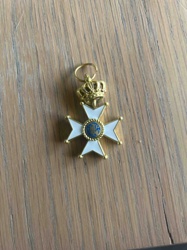
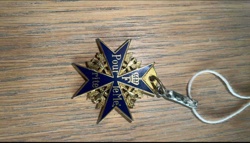
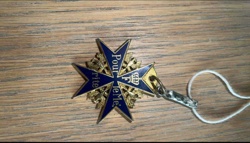
The missing pour le merite that dissapeared from Germany that is said to be owned by Noah dohme that is the emperor of lixland because I am him
These notes were written by the person who submitted this item. Appraiser.AI has not verified them, and the AI's identification and estimate may rely on them.
AI Estimated Value
Not an official valuation
$65,000 - $95,000
AI estimate as of July 2, 2025 · verify with a professional before acting
AI-Generated · Verify before acting
Everything on this page is generated by AI for informational purposes only. AI can make mistakes — the AI may misidentify items or misattribute them (artist, maker, brand, designer, origin, era). This is not an official valuation and should not be used for insurance, sale, tax, estate, legal, or lending purposes — or any decision requiring a certified appraisal. It is not an authoritative claim about any person, brand, or rights holder — do not share or rely on it as a factual statement about a third party. Always consult qualified professionals before making financial decisions.
This analysis also relies on unverified notes provided by the user, which may be incomplete or inaccurate and could affect the result.
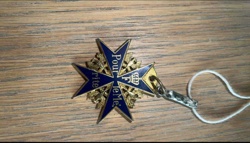
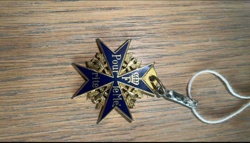
This item is a decorative medal, designed in the shape of a Maltese cross, commonly known as a 'Pour le Mérite' or 'Blue Max'. The cross itself is primarily blue enamel with gold gilt edges and gold details within the arms. Each arm of the cross features stylized golden eagles with outstretched wings, and the center intersection of the arms includes golden royal cyphers (visible as 'F W' under a crown) on three arms and the phrase 'Pour le Mé.' on one arm, and 'rite' on another. The entire cross is superimposed on a gold wreath of laurels. The medal appears to be crafted from metal, likely gilt bronze or gold, with an applied dark blue enamel. The craftsmanship suggests a period manufacturing process, with fine detail on the eagles and the intricate wreath. There are some visible signs of wear, including minor scuffs or scratches on the blue enamel, particularly on the edges and raised surfaces, consistent with its age and use. The gold gilding shows some areas of rubbing or slight discoloration, revealing the base metal beneath. A small loop at one arm of the cross is attached to a metal clasp or hook, which then has a white string or thread tied to it. This string appears to be a modern addition, possibly for display or temporary attachment, and is not original to the medal's intended ribbon system. The overall condition suggests it is an authentic period piece, possibly from the late 19th or early 20th century, given the historical context of the 'Pour le Mérite' as a Prussian military honor. The details like the 'F.W.' monarchial cypher (for Friedrich Wilhelm) confirm its Prussian origin. The patina on the metal elements indicates age rather than new production. The quality of the enamel application and metalwork is high, consistent with a prestigious military award.
AI Appraisal Report
Upon examining the provided image and description of this 'Pour le Mérite' medal, I note its detailed craftsmanship consistent with period examples. The blue enamel, gilt edges, golden eagles, and 'F W' cyphers indicate a Prussian origin. The visible wear, including minor scuffs on the enamel and rubbing on the gilding, suggests authentic age and use, not modern fabrication. The patina on the metal elements also supports its vintage status. The additional white string is clearly a non-original, temporary attachment. Based on these visual cues, the item appears to be an authentic 'Pour le Mérite' medal, likely from the late 19th or early 20th century.
However, it is crucial to state that a definitive authentication, especially given the historical significance and high value of such an item, cannot be fully established from images alone. A physical in-hand examination is imperative to assess weight, exact material composition, specific manufacturing techniques, and microscopic details that distinguish genuine pieces from advanced fakes. Furthermore, comprehensive provenance documentation is critical. The claim of this being 'the missing Pour le Mérite that disappeared from Germany owned by Noah Dohme, Emperor of Lixland,' while an interesting narrative, requires verifiable, concrete evidence to support its authenticity and chain of ownership. Without this, it remains an unsubstantiated claim that does not factor into its base appraisal value as a genuine article. Scientific testing (e.g., elemental analysis) and expert authentication by a specialized dealer in militaria would be necessary to confirm absolute authenticity and specific dating.
In the market, genuine Pour le Mérite medals are exceedingly rare and highly sought after by collectors of military history and German awards. Demand consistently outstrips supply, especially for examples in good condition with strong provenance. The rarity, historical significance, and prestige associated with Imperial German military awards drive significant value. Comparables typically sell in the upper five figures to low six figures, depending heavily on condition and provenance.