AI Appraisal Estimate

AI-generated estimates · not official valuations

From the user

What was submitted

Photo and notes provided by the user — not generated by AI

Submitted item photo
Submitted photo · June 23, 2026

User's notes

Luigi kasimir

AI analysis below

AI appraisal

AI analysis & estimate

AI-Generated · Verify before acting

Everything below is generated by AI for informational purposes only. AI can make mistakes — the AI may misidentify items or misattribute them (artist, maker, brand, designer, origin, era). This is not an official valuation and should not be used for insurance, sale, tax, estate, legal, or lending purposes — or any decision requiring a certified appraisal. It is not an authoritative claim about any person, brand, or rights holder — do not share or rely on it as a factual statement about a third party. Always consult qualified professionals before making financial decisions.

Note

This analysis also relies on unverified notes provided by the user, which may be incomplete or inaccurate and could affect the result.

Read the full disclaimer

AI Identification

·Not independently authenticated·Verify before acting

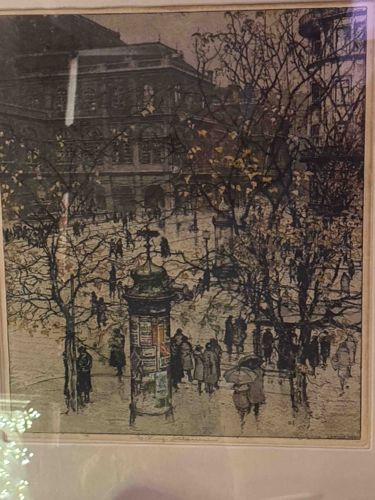
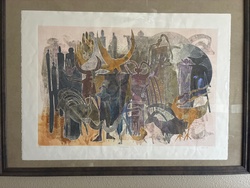
Luigi Kasimir: Vienna Opera House Square (Opernplatz in Wien)

Fine Art - Prints & Multiples

AI Estimated Value

·Not an official valuation·Verify before acting

$600-900

As of June 23, 2026

AI Item Analysis

·AI can make mistakes·Verify before acting
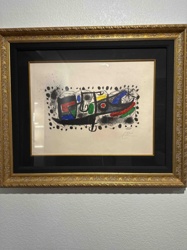
This item is an original color etching with aquatint by the renowned Austro-Hungarian artist Luigi Kasimir (1881–1962). The artwork depicts a bustling scene at the Vienna Opera House Square, likely dating from the early to mid-20th century (circa 1920s-1940s). The composition features intricate architectural detailing of the Opera House in the background, contrasting with the organic forms of bare, wintery trees in the foreground. A prominent Morris column covered in posters serves as a focal point in the middle ground, surrounded by pedestrians holding umbrellas, suggesting a rainy day in the city. The artist's signature is visible in the lower margin, characteristic of his graphite-signed pieces. The print utilizes a soft, atmospheric color palette typical of Kasimir’s multi-plate technique, incorporating muted grays, ambers, and dark shadows to create depth. Physically, the piece appears to be framed under glass with a light-colored mat. There is visible evidence of light-toning and mild foxing on the paper margins, which is common for works of this age. The etching displays the high-quality craftsmanship of a master printmaker, including sharp plate marks and delicate tonal gradations. The condition appears fair to good, though a professional examination out of the frame would be required to rule out more significant acid burn or mounting issues. As an example of Kasimir’s iconic cityscapes, this piece represents a classic European architectural style and is a staple of mid-century print collecting.
AI Appraisal Report

·AI can make mistakes·Verify before acting
I have examined the provided details for the Luigi Kasimir color etching 'Vienna Opera House Square.' This piece exemplifies Kasimir’s mastery of the multi-plate color etching process, specifically his ability to capture the atmospheric mood of post-WWI Vienna. Based on the visual evidence, the piece features a hand-signed graphite signature rather than the estate-stamped versions which command significantly less value. The plate marks appear distinct, and the tonal gradations in the aquatint are consistent with a lifetime impression. The condition is currently the primary variable. My observation of light toning and mild foxing suggests the work has been subject to non-archival mounting or UV exposure. While these are common for early 20th-century prints, they necessitate a 'Fair to Good' grading. The market for Kasimir remains steady among collectors of European architectural prints, though values have plateaued from their peak in the late 1990s. Similar subjects in this size and condition typically realize between $600 and $900 at auction. Note: This appraisal is based on photographic evidence alone. Absolute authentication is limited without physical inspection. To finalize this assessment, I would require an examination out of the frame to check for 'acid burn' on the paper's verso, thinning (skinning), or evidence of dry-mounting. Verification of the paper’s watermark (such as 'Holland') and a microscopic look at the ink-lay would further confirm this is an original etching rather than a high-quality photogravure reproduction. Provenance documentation regarding its original acquisition would also bolster the valuation.

Get your items appraised

Instant estimates of your treasures with AI-powered appraisals

Browse More Appraisals