AI estimate as of September 25, 2026 · verify with a professional before acting
AI-Generated · Verify before acting
Everything on this page is generated by AI for informational purposes only. AI can make mistakes — the AI may misidentify items or misattribute them (artist, maker, brand, designer, origin, era). This is not an official valuation and should not be used for insurance, sale, tax, estate, legal, or lending purposes — or any decision requiring a certified appraisal. It is not an authoritative claim about any person, brand, or rights holder — do not share or rely on it as a factual statement about a third party. Always consult qualified professionals before making financial decisions.
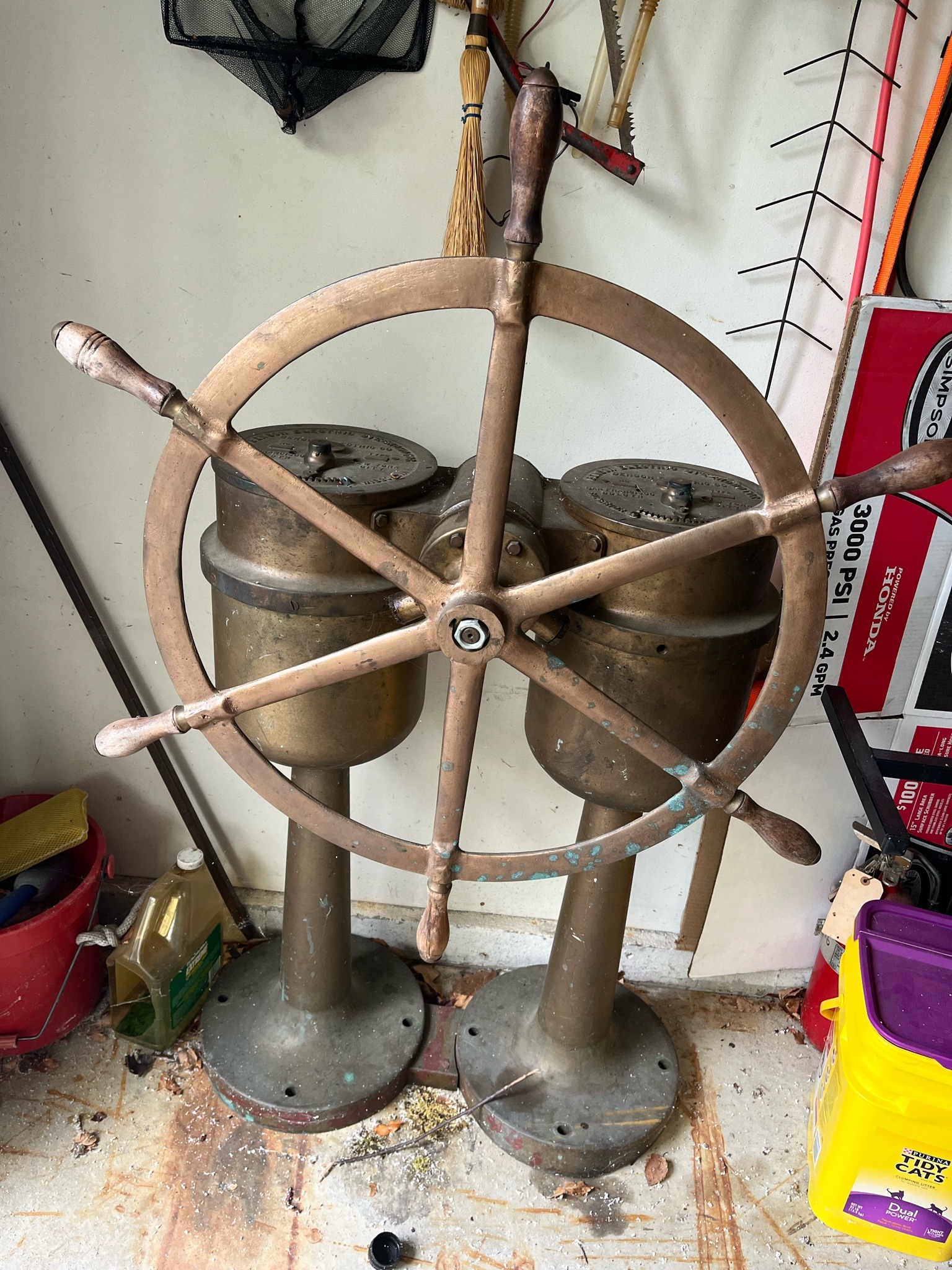
This is a large, heavy nautical apparatus consisting of a central brass ship's steering wheel mounted in front of a dual-pedestal mechanical unit, likely a ship's engine order telegraph system. The primary material is cast brass or bronze, showing a heavy natural tarnish, surface oxidation, and areas of green verdigris accumulation particularly around the joints and lower bases, which is consistent with age and maritime exposure. The steering wheel features eight spokes, each terminating in a turned wooden handle grip showing visible wear and grain. The central hub of the wheel is secured with a modern hex nut and washer assembly. Behind the wheel stand two cylindrical brass housings mounted on flared conical pedestals that bolt directly to the floor. The top caps of both cylindrical units feature circular cast lettering and text rings, though the exact text is partially obscured in the image. The entire assembly displays substantial weight and industrial marine craftsmanship, likely originating from a mid-20th-century or earlier vessel, though no exact date or maker can be verified from the image alone. The identification relies entirely on the visual presence of a classic marine wheel configuration combined with dual binnacle-style pedestals, and the item remains unauthenticated.
AI Appraisal Report
Based on what I can see in the photograph, this piece presents as a large, heavy nautical apparatus combining a brass ship's steering wheel with a dual-pedestal mechanical unit resembling an engine order telegraph system. The cast brass or bronze shows a heavy natural tarnish, surface oxidation, and areas of green verdigris accumulation around the joints and lower bases, which visually aligns with age and maritime exposure. However, I can't verify from a photo alone the metal alloy composition, the internal mechanical integrity of the pedestals, or whether the modern hex nut and washer assembly on the steering wheel hub indicates recent repairs or alterations. The value estimate range of $1,500 to $2,500 is provided for an item of this type assuming the attribution to a mid-20th-century or earlier working vessel is correct. Nautical antiques of this scale and decorative industrial presence appeal to collectors of maritime decor, interior designers, and specialty enthusiasts, with market demand typically driven by visual impact and decorative usability. Condition heavily influences this valuation; while the aged patina is desirable, any significant structural compromise or mismatched replacement components would impact desirability. Because this piece remains unauthenticated, this valuation is strictly conditional. If the apparatus turns out to be a decorative reproduction, modern replica, or a piece produced 'in the style of' vintage maritime equipment rather than an actual vessel-removed artifact, the market value would drop substantially, typically falling closer to $300 to $600. To firmly establish authenticity, age, and potential historical origin, physical inspection by a qualified maritime expert would be needed to examine internal mechanisms, mounting hardware, and any obscured maker's marks or foundry stamps.