Late 19th or Early 20th Century Oval Wire-Rim Spectacles
Antique Eyewear / Medical Curiosities

Late 19th or Early 20th Century Oval Wire-Rim Spectacles

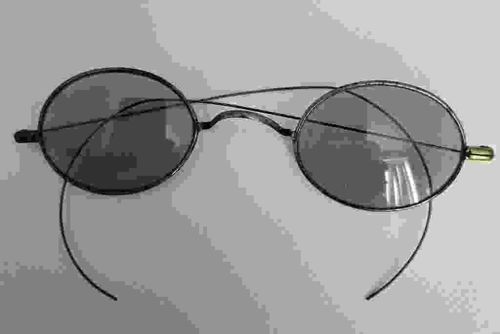
This item is a pair of antique wire-rimmed spectacles, likely dating from the late Victorian to the early Edwardian era (circa 1880–1910). The glasses feature small, horizontally oriented oval lenses set within a slender, dark grey or oxidized metal frame, likely made of nickel-silver, steel, or a gold-filled alloy. A defining characteristic is the 'C-bridge' or saddle bridge, which lacks nose pads and rests directly on the bridge of the wearer's nose, a style common before the 1920s. The temples are of the 'riding bow' or cable variety, designed with thin, flexible wire that curves almost entirely around the ear to ensure the glasses stayed secure during activity. While the lenses appear translucent in the image, they may be prescription glass or early tinted sun-protection lenses. Notable features include the simple screw hinge construction and the lack of maker's marks visible in the photograph, though such marks are often found stamped on the inside of the bridge or on the temple arms in professional appraisals. Condition-wise, the frames show a consistent patina indicative of age, with some slight asymmetry in the wire temples and potential minor oxidation on the metal surfaces. These frames represent the utilitarian craftsmanship of late 19th-century optical manufacturing, where durability and a minimalist profile were prioritized over the decorative flourishes found in later eyewear styles.

Estimated Value

$45–$85

Basic Information

Category

Antique Eyewear / Medical Curiosities

Appraised On

April 5, 2026

Estimated Value

$45–$85

Item Description

This item is a pair of antique wire-rimmed spectacles, likely dating from the late Victorian to the early Edwardian era (circa 1880–1910). The glasses feature small, horizontally oriented oval lenses set within a slender, dark grey or oxidized metal frame, likely made of nickel-silver, steel, or a gold-filled alloy. A defining characteristic is the 'C-bridge' or saddle bridge, which lacks nose pads and rests directly on the bridge of the wearer's nose, a style common before the 1920s. The temples are of the 'riding bow' or cable variety, designed with thin, flexible wire that curves almost entirely around the ear to ensure the glasses stayed secure during activity. While the lenses appear translucent in the image, they may be prescription glass or early tinted sun-protection lenses. Notable features include the simple screw hinge construction and the lack of maker's marks visible in the photograph, though such marks are often found stamped on the inside of the bridge or on the temple arms in professional appraisals. Condition-wise, the frames show a consistent patina indicative of age, with some slight asymmetry in the wire temples and potential minor oxidation on the metal surfaces. These frames represent the utilitarian craftsmanship of late 19th-century optical manufacturing, where durability and a minimalist profile were prioritized over the decorative flourishes found in later eyewear styles.
Get Your Items Appraised

Instant estimates of your treasures with AI-powered instant appraisals

Browse More Appraisals