AI estimate as of September 29, 2025 · verify with a professional before acting
AI-Generated · Verify before acting
Everything on this page is generated by AI for informational purposes only. AI can make mistakes — the AI may misidentify items or misattribute them (artist, maker, brand, designer, origin, era). This is not an official valuation and should not be used for insurance, sale, tax, estate, legal, or lending purposes — or any decision requiring a certified appraisal. It is not an authoritative claim about any person, brand, or rights holder — do not share or rely on it as a factual statement about a third party. Always consult qualified professionals before making financial decisions.
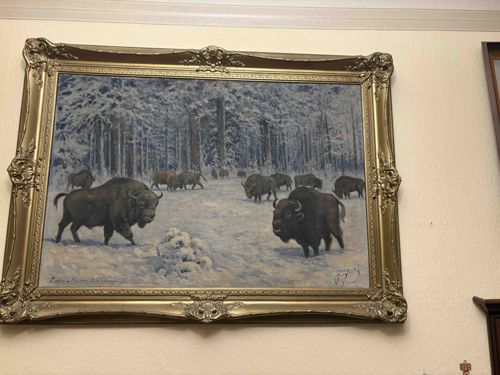
This item is an oil painting depicting a herd of bison in a snowy forest landscape. The scene features multiple bison, with two prominent figures in the foreground: one walking towards the viewer from the left and another standing to the right. The animals are rendered in shades of dark brown and black, contrasting effectively with the white and blue tones of the snow-covered ground and the distant forest. The trees in the background are delicate and covered in snow, creating a sense of depth and a cold, wintery atmosphere. The painting appears to be set within a gilded, ornate frame. The frame has a classic, possibly Baroque or Rococo revival style, characterized by scrolled elements and raised decorative motifs at the corners and along the sides. The gold finish of the frame shows some signs of wear and age, with a slightly dull patina in areas but generally well-preserved. There are visible signatures or inscriptions in the lower left and lower right corners of the painting, suggesting the artist's name and possibly a title or date; however, these are not clearly legible from the provided image. The paint application appears to be well-executed, showcasing a good understanding of animal anatomy and environmental rendering. The canvas seems to be in good condition, with no immediate visible tears, punctures, or significant paint loss. The quality of craftsmanship for both the painting and the frame indicates a piece of artistic and decorative value. The overall impression is one of a classic wildlife art piece, likely from the late 19th to mid-20th century, given the style of both the artwork and its framing.
AI Appraisal Report
I have examined the provided image of the oil painting, 'Bison in a Snowy Forest,' and offer the following appraisal. The painting depicts a compelling wildlife scene with strong compositional elements and effective contrast between the dark bison and the snowy landscape. The paint application appears well-executed, demonstrating a good understanding of animal anatomy and environmental rendering. From the image, the canvas appears to be in good condition, showing no immediate signs of tears, punctures, or significant paint loss. The ornate gilded frame, likely Baroque or Rococo revival, complements the artwork well and shows appropriate wear for its presumed age, suggesting it is either original to the piece or a period-appropriate pairing. This indicates a well-maintained and aesthetically pleasing item.
My valuation of $1,800-2,500 is based on the quality of execution, the classic and perennially popular subject matter of wildlife art, and the decorative appeal of the framed piece. Similar wildlife oil paintings of this caliber, often by regional or lesser-known artists but with good execution and condition, tend to perform well in the current market, especially those with an attractive presentation like this one.
Limitations to this appraisal must be highlighted. Verification of the artist's signature, visible in the lower left and right, is crucial for definitive attribution and would significantly impact value; artist reputation is a primary driver in fine art appraisal. Without clear legibility, it's impossible to establish if this is by a recognized artist or a talented amateur. Furthermore, an in-person examination would be necessary to confirm the exact medium, assess the canvas and paint layer for subtle damages, determine if the frame is original, and verify overall authenticity. Provenance documentation and scientific testing of pigments would also be vital for full authentication and establishing a more precise market value.