These notes were written by the person who submitted this item. Appraiser.AI has not verified them, and the AI's identification and estimate may rely on them.
AI Estimated Value
Not an official valuation
$450-750
AI estimate as of August 16, 2025 · verify with a professional before acting
AI-Generated · Verify before acting
Everything on this page is generated by AI for informational purposes only. AI can make mistakes — the AI may misidentify items or misattribute them (artist, maker, brand, designer, origin, era). This is not an official valuation and should not be used for insurance, sale, tax, estate, legal, or lending purposes — or any decision requiring a certified appraisal. It is not an authoritative claim about any person, brand, or rights holder — do not share or rely on it as a factual statement about a third party. Always consult qualified professionals before making financial decisions.
This analysis also relies on unverified notes provided by the user, which may be incomplete or inaccurate and could affect the result.
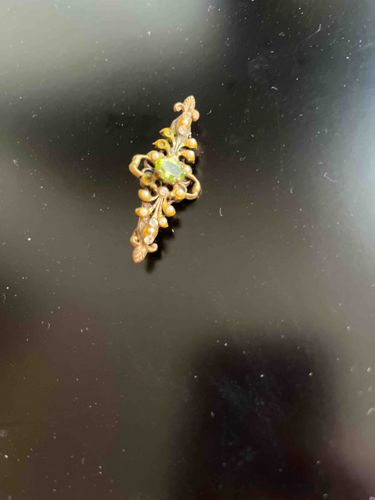
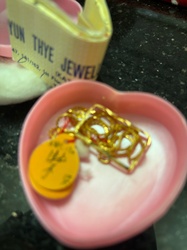
This appears to be an antique or vintage pendant, possibly designed to be worn on a necklace or as a chatelaine accessory. The pendant's design is highly ornate and asymmetrical, suggesting a potential Art Nouveau or late Victorian aesthetic, likely from the late 19th or early 20th century. It features a prominent oval-cut green gemstone, possibly a peridot or green glass imitation, centrally set and surrounded by intricate metalwork. The metal appears to be a gold-toned alloy, possibly brass, gold-filled, or a low-carat gold, displaying a significant amount of patina and discoloration consistent with age, appearing somewhat darkened and dull in areas. The design incorporates scrolling foliate motifs, resembling vines or leaves, embellished with numerous small, round, bead-like elements that could be seed pearls or small metal beads. Some of these small beads appear slightly irregular in shape and size. There are also smaller, clear or very light-colored stones, possibly small diamonds, paste, or glass, integrated into the design, though their clarity and setting are difficult to ascertain from the image. The overall construction implies a delicate, handcrafted quality, typical of periods favoring intricate details. There are visible signs of wear, including surface abrasions and potential tarnishing on the metal. The condition of the central green stone seems fair, with some reflections obscuring precise details about its facets and surface. No discernible maker's marks or signatures are visible in the provided images, so the exact manufacturer or origin is unknown without further inspection. The craftsmanship indicates a piece intended for decorative rather than purely functional use, with attention paid to aesthetic balance despite its asymmetry.
AI Appraisal Report
Upon examining the image of this Victorian/Art Nouveau style green gemstone and seed pearl pendant, I assess it as a charming vintage piece, likely dating from the turn of the 20th century. The intricate, asymmetrical scrolling foliate motifs, prominent central oval green gemstone, and seed pearl accents strongly align with the aesthetic trends of the late Victorian to early Art Nouveau periods. The metal's gold tone, combined with significant patina and discoloration, suggests it could be gold-filled, low-carat gold, or even a high-quality brass. Without physical examination, determining the exact metal composition is impossible; this is a critical factor impacting value. The central green stone appears to be peridot or potentially green glass, given the general clarity and reflection observed. The numerous small, round bead-like elements are likely seed pearls, though their irregularity hints at natural origin, which adds to the charm. The smaller, clear stones would need magnification to determine if they are diamonds, paste, or glass.
In terms of condition, there are visible signs of wear consistent with age, including surface abrasions and tarnishing, which is expected for an item of this vintage. The overall construction appears delicate yet sturdy for its age.
Market conditions for period jewelry, particularly Art Nouveau and late Victorian pieces, remain stable, with demand for authentic, well-preserved examples. This pendant's intricate design and apparent age make it desirable to collectors. However, limitations in authenticity verification from images alone are significant. I cannot definitively ascertain the gemstone type, pearl origin (natural vs. cultured/imitation), or metal purity. An in-person examination would be crucial to perform tests like specific gravity for the gemstone, observe pearl luster and nacre quality, and test the metal. Provenance documentation, if available, would also significantly enhance its value by verifying its history. Without these verifications, the valuation remains conservative.
Factors significantly impacting value include the actual composition of the green stone (peridot vs. glass), the type of pearls (natural vs. imitation), and especially the metal (gold vs. gold-filled vs. base metal). Rarity is moderate; while intricate, such designs were common during the period. Based purely on visual assessment and assuming gold-filled metal, a peridot, and natural seed pearls, I place its value conservatively. If it were solid gold and the stones were natural peridot and diamonds, the value would be substantially higher.