These notes were written by the person who submitted this item. Appraiser.AI has not verified them, and the AI's identification and estimate may rely on them.
AI Estimated Value
Not an official valuation
$600-900
AI estimate as of September 9, 2025 · verify with a professional before acting
AI-Generated · Verify before acting
Everything on this page is generated by AI for informational purposes only. AI can make mistakes — the AI may misidentify items or misattribute them (artist, maker, brand, designer, origin, era). This is not an official valuation and should not be used for insurance, sale, tax, estate, legal, or lending purposes — or any decision requiring a certified appraisal. It is not an authoritative claim about any person, brand, or rights holder — do not share or rely on it as a factual statement about a third party. Always consult qualified professionals before making financial decisions.
This analysis also relies on unverified notes provided by the user, which may be incomplete or inaccurate and could affect the result.
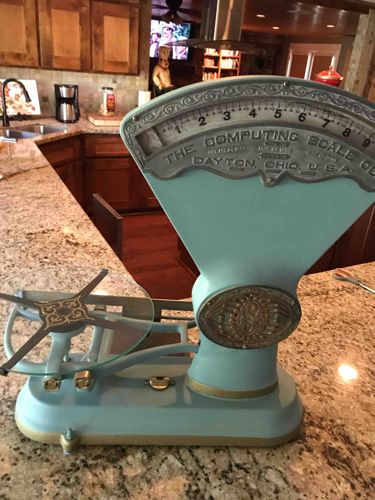
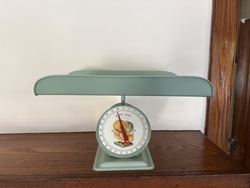
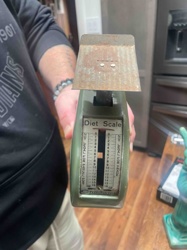
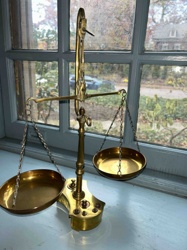
This is an antique counter-top computing scale, likely used in a general store or grocery. The scale features a distinctive pale aqua or light teal color, possibly a professional repaint, with subtle gold or brass accents outlining the base and decorative elements. It appears to be constructed primarily from cast iron or a similar heavy metal, providing stability and durability. The scale displays a "fan" or "angle" indicator with embossed numbers from 0 to 9, indicating the weight. Prominently embossed on the face is "THE COMPUTING SCALE CO." and "DAYTON, OHIO, U.S.A.", clearly identifying the manufacturer and origin. The design suggests a late 19th to early 20th-century style, characteristic of commercial scales from that era. The weighing platform consists of a detailed ornate metal support structure, possibly brass or bronze, that holds a circular glass plate. The glass plate looks intact, though its thickness cannot be fully assessed. There are visible signs of age and wear, including chipping paint, minor surface abrasions, and a generally aged patina on the metal parts, particularly on the gold-toned accents and the embossed areas. The base includes adjustable feet, one of which is visible and appears to be made of brass or a similar metal, allowing for leveling. An ornamental oval medallion with intricate scrolling designs is affixed to the main standard of the scale, adding to its vintage appeal and quality craftsmanship. The overall condition suggests it has been well-preserved or restored.
AI Appraisal Report
Upon examining the provided image and details of this Antique Computing Scale Co. Store Scale, I find it to be an authentic piece from the late 19th to early 20th century, consistent with scales manufactured by 'The Computing Scale Co. Dayton, Ohio, U.S.A.' The embossed details and overall design strongly support its authenticity. Its aesthetic appeal is significantly enhanced by the distinctive pale aqua/light teal coloration, which, even if a professional repaint, complements its vintage charm. The visible signs of age—chipping paint, surface abrasions, and aged patina—are expected for an item of this vintage and contribute to its character rather than detracting significantly from value, suggesting regular use and natural wear. The intact glass plate and ornamental details are definite positives.
Market conditions for antique commercial scales, particularly well-preserved or tastefully restored examples, remain stable. There's a consistent demand from collectors of general store memorabilia, industrial antiques, and those seeking unique decorative pieces. While not exceedingly rare, scales from "The Computing Scale Co." are sought after for their quality and historical significance. The primary factor impacting value here is the appealing color and seemingly good overall structural integrity. The functional aspect (accuracy of weighing) cannot be determined via images, which would be a significant factor for some collectors.
My primary limitation in authenticity verification from images alone is confirming the original color and the extent/quality of any restoration or repaint. A hands-on examination would allow me to assess the soundness of all mechanisms, confirm material compositions (e.g., brass versus brass-plated), evaluate the extent of wear on moving parts, and determine if the scale is in working order. Provenance documentation, such as original sales receipts or historical ownership records, would further enhance value by providing a documented history. Scientific testing, like paint analysis, could confirm historical color accuracy if desired by a purist collector.