AI estimate as of August 15, 2025 · verify with a professional before acting
AI-Generated · Verify before acting
Everything on this page is generated by AI for informational purposes only. AI can make mistakes — the AI may misidentify items or misattribute them (artist, maker, brand, designer, origin, era). This is not an official valuation and should not be used for insurance, sale, tax, estate, legal, or lending purposes — or any decision requiring a certified appraisal. It is not an authoritative claim about any person, brand, or rights holder — do not share or rely on it as a factual statement about a third party. Always consult qualified professionals before making financial decisions.
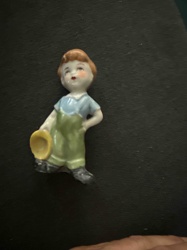
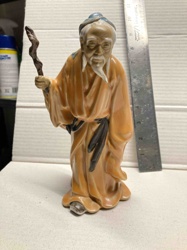
This is a ceramic or porcelain figurine depicting a young, child-like figure, likely of East Asian origin, possibly a Japanese or Chinese character. The figure appears to be a boy, distinguished by a subtle hair knot on top of his head. He is dressed in what resembles a traditional kimono or robe, colored in a muted, mossy green hue. The sleeves are wide, and the garment features some painted decorative elements or folds in a darker green or brown, simulating fabric texture. His face is round and plump, with a light, almost porcelain-like skin tone. The eyes are painted in an almond shape with dark pupils, giving a serene or slightly melancholic expression. He has subtle rosy cheeks and no visible mouth, which is common in some stylized figurines. The most prominent feature held by the figure is a red fish, possibly a snapper or a similar type, with white and pink accents representing scales and fins. The fish is held horizontally in the figure's arms, resting on what appears to be a small, light-brown or beige base, perhaps an offering plate or simply part of the integrated design. The craftsmanship suggests a molded and painted technique. There are no obvious signs of significant damage like chips or cracks visible in the image, suggesting good overall condition. The finish appears matte or semi-glossy, particularly on the robe and skin, while the fish might have a slightly glossier finish to emphasize its scales. The size appears to be typical for a tabletop figurine, likely between 8 to 12 inches in height, judging by its proportion to the coffee table and remote control. No manufacturer's marks or signatures are discernible from the provided image. The style suggests it could be from the mid-20th century or later, possibly a mass-produced decorative item.
AI Appraisal Report
Upon visual examination of the provided image, I assess this ceramic or porcelain figurine to be in good overall condition. There are no readily apparent chips, cracks, or significant damage. The matte to semi-glossy finish appears intact across the robe and skin, with the fish possibly having a slightly glossier sheen. Authenticity, based solely on this image, seems to lean towards a mass-produced decorative item rather than a unique artisan piece. The stylized features, particularly the lack of a mouth and the uniform painting, are typical of such items. Its East Asian origin, likely Japanese or Chinese, is suggested by the physical characteristics and attire.
Market conditions for such decorative figurines can vary widely. Without discernible manufacturer's marks or a known artist, its value is primarily driven by aesthetic appeal and condition. Comparable sales of similar mid-20th century or later ceramic decorative pieces, especially those without established provenance or artist attribution, typically fall into the lower-to-mid range of the collectible market. Demand for these specific types of figurines is moderate; while there's a niche of collectors, they are not considered rare.
The most significant factors impacting its value are the absence of any manufacturing marks (which could indicate a known company like Lefton, Napco, or Hummel for similar types of figurines) and the likelihood of it being a mass-produced item. Its good condition is a positive factor, however. For full authentication and to ascertain a more precise value range, an in-person examination would be crucial to check for hidden marks, assess the true quality of the ceramic (e.g., bone china vs. standard porcelain), and detect any subtle repairs or flaws not visible in the photo. Provenance documentation, if available, would significantly enhance its value, especially if it linked the piece to a specific artist or manufacturer. Scientific testing, like material analysis, would only be pursued if there were strong indications of historical significance or high value based on initial visual assessment, which is not the case here.