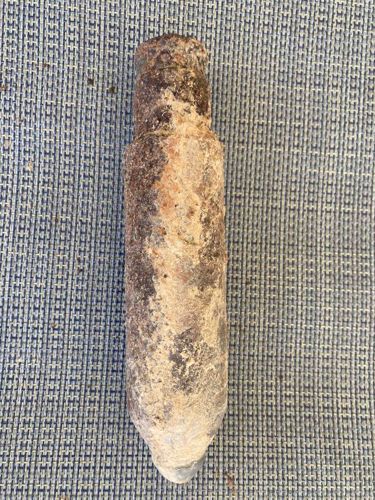
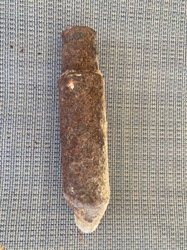
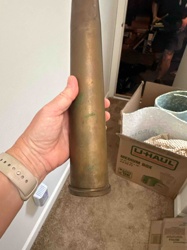
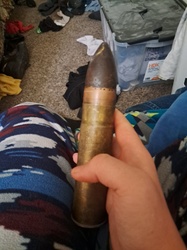
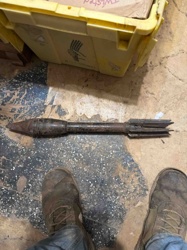
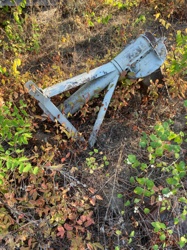
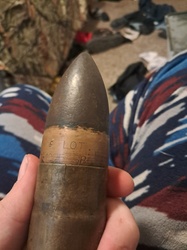
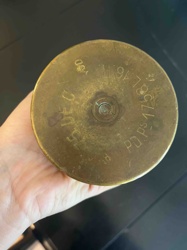
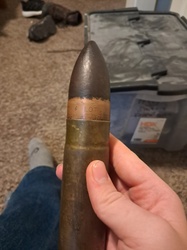
Found some type of artillery shell about 12” long weighs about 3 lbs
These notes were written by the person who submitted this item. Appraiser.AI has not verified them, and the AI's identification and estimate may rely on them.
AI Estimated Value
Not an official valuation
$25-75
AI estimate as of August 20, 2025 · verify with a professional before acting
AI-Generated · Verify before acting
Everything on this page is generated by AI for informational purposes only. AI can make mistakes — the AI may misidentify items or misattribute them (artist, maker, brand, designer, origin, era). This is not an official valuation and should not be used for insurance, sale, tax, estate, legal, or lending purposes — or any decision requiring a certified appraisal. It is not an authoritative claim about any person, brand, or rights holder — do not share or rely on it as a factual statement about a third party. Always consult qualified professionals before making financial decisions.
This analysis also relies on unverified notes provided by the user, which may be incomplete or inaccurate and could affect the result.
This item appears to be a heavily corroded and encrusted projectile, likely a large caliber bullet or a small artillery shell, consistent with the provided dimensions of approximately 12 inches in length and a weight of around 3 pounds. The overall shape is cylindrical with a distinct, tapered or pointed tip at one end and a slightly narrower, truncated base at the other. Given the heavily weathered state, it is challenging to discern the original material, though it strongly suggests a ferrous metal, possibly steel or iron, undergoing significant oxidation. The surface is almost entirely obscured by a thick, uneven layer of rust, corrosion, and what appears to be dirt or mineral accretions, indicating prolonged exposure to corrosive elements, potentially burial or submersion. There are no discernible markings, maker's stamps, or signatures visible due to the extensive surface degradation. The construction seems simple, a solid or hollow core projectile, typical of early to mid-20th century or even late 19th-century munitions. The condition issues are severe, primarily deep pitting, flaking, and complete loss of original surface finish due to advanced corrosion. There are no obvious signs of recent damage or repair, but rather a uniform patina of extreme age and neglect. Its appearance suggests it is a 'dug' item, possibly from a battlefield or an excavation site. The craftsmanship, while not fully observable, appears to be industrial and functional, designed for military application rather than aesthetic appeal. This projectile is likely inert, having long since lost any explosive components, if it ever contained them, due to its deteriorated state and age.
AI Appraisal Report
I have examined the provided image and information regarding this heavily corroded projectile. Based on its dimensions (approximately 12 inches long, 3 lbs weight) and form, it appears consistent with a large caliber bullet or small artillery shell, likely from the late 19th or early to mid-20th century. The condition is severe, characterized by extensive rust, deep pitting, and mineral encrustations, indicative of prolonged exposure to harsh environmental conditions, possibly burial. This heavy corrosion obscures any potential manufacturer markings or finer details, making definitive identification of its exact type, origin, or caliber impossible from visuals alone.
Authenticity as a genuine period projectile seems probable given the extent of the corrosion, which is difficult to replicate artificially convincingly. However, precise authenticity and intended purpose (e.g., inert practice round vs. live shell) cannot be fully verified without in-person inspection. An in-hand examination would allow for precise measurements, identification of any subtle forms, and potentially the presence of residual materials or internal components. Further authentication would benefit from X-ray analysis to determine internal structure and material composition, and professional conservation to reveal any obscured markings. Provenance documentation, such as excavation reports or historical records, would significantly enhance its value by confirming its origin.
In terms of market conditions, heavily corroded and unidentified ordnance typically has limited appeal to serious collectors unless it originates from a historically significant site or can be positively identified as a rare variant. The severe condition significantly depreciates its value, as it largely serves as an inert curiosity rather than a piece with historical or aesthetic merit for display. Demand for such items is generally low, appealing mostly to enthusiasts of 'dug' relics or those interested in military archeology, rather than high-end collectors. Comparable items in similar condition often sell at the lower end of the military collectible spectrum.
The primary factor significantly impacting value is its poor, unidentified condition. While undoubtedly a genuine artifact, its lack of specific provenance, identity, and severe degradation mean it fetches a minimal price. Without conservation and further identification, its value remains primarily as an archaeological curiosity.