AI estimate as of August 8, 2025 · verify with a professional before acting
AI-Generated · Verify before acting
Everything on this page is generated by AI for informational purposes only. AI can make mistakes — the AI may misidentify items or misattribute them (artist, maker, brand, designer, origin, era). This is not an official valuation and should not be used for insurance, sale, tax, estate, legal, or lending purposes — or any decision requiring a certified appraisal. It is not an authoritative claim about any person, brand, or rights holder — do not share or rely on it as a factual statement about a third party. Always consult qualified professionals before making financial decisions.
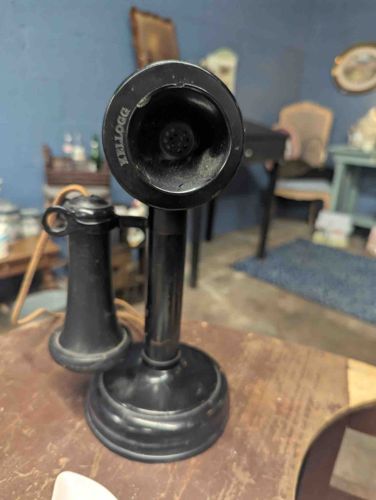
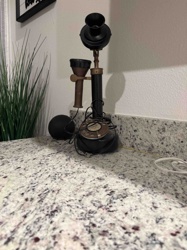
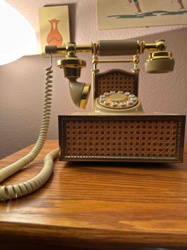
This item is an antique Kellogg 'Pillar' or 'Candlestick' telephone, characterized by its upright, slender form. The phone is constructed primarily of black-painted metal, possibly cast iron or steel, which gives it a substantial, durable appearance. The dominant color is a matte black, showing some wear and scuffs consistent with age and use, particularly around the base and on raised edges. The central column rises vertically from a stepped, circular base. Attached to the side of the column is a cupped receiver, also in black, suspended from a hook or cradle designed for it. The mouthpiece directly surmounts the central column; it is a large, flared horn-like component with a grille-covered speaking diaphragm at its center. The branding 'KELLOGG' is clearly visible in raised lettering around the rim of the mouthpiece, indicating its manufacturer, Kellogg Switchboard & Supply Company. The visible cord extending from the receiver appears to be fabric-wrapped and shows some fraying or discoloration. There are no obvious signs of major damage like cracks or significant dents, but the paint finish exhibits a patinated look with areas of minor chipping and surface wear, testifying to its age. The craftsmanship appears robust, typical of early 20th-century industrial manufacturing, designed for functionality and longevity. Based on the design and visible branding, this particular style of telephone likely dates to the early 20th century, probably between 1900 and the 1920s.
AI Appraisal Report
I have carefully examined the provided image of this Kellogg 'Pillar' or 'Candlestick' telephone. Based on my visual assessment, the item appears to be an authentic Kellogg Switchboard & Supply Company telephone, consistent with models produced in the early 20th century (c. 1900-1920s), indicated by the 'KELLOGG' branding on the mouthpiece and the typical design features of the era. The condition is good for its age; the matte black paint shows expected wear, scuffs, and minor chipping, which contribute to its antique patina rather than detracting significantly from its appeal. There are no apparent major structural damages, although the fabric-wrapped cord shows fraying, which is common. This wear aligns with decades of use and handling.
From a market perspective, candlestick telephones, particularly those from well-known manufacturers like Kellogg, Western Electric, and Automatic Electric, maintain steady demand among collectors of antique telecommunications devices. Their iconic silhouette makes them desirable decorative pieces even if not fully functional. Rarity is moderate; while not exceedingly rare, original, largely intact examples like this one are not flooding the market. Comparables for similar Kellogg candlestick phones in this condition typically range from $150 to $350. Factors influencing value include the original unrestored finish, clear branding, and the absence of significant repairs or missing parts.
It is important to note the limitations of an appraisal based solely on images. While authenticity appears strong, an in-person examination would be crucial to confirm the originality of all components, assess internal mechanisms (which significantly impact functionality and by extension, collectibility for some), and verify material integrity without surface obscuration. Provenance documentation, such as original purchase records or family history, would further solidify authenticity and potentially add to its narrative value. Without physical inspection, I cannot confirm if the phone is fully operational or if any internal components have been replaced, which could affect the higher end of its value range.