These notes were written by the person who submitted this item. Appraiser.AI has not verified them, and the AI's identification and estimate may rely on them.
AI Estimated Value
Not an official valuation
$800 - $1,200 (for the pair)
AI estimate as of October 19, 2025 · verify with a professional before acting
AI-Generated · Verify before acting
Everything on this page is generated by AI for informational purposes only. AI can make mistakes — the AI may misidentify items or misattribute them (artist, maker, brand, designer, origin, era). This is not an official valuation and should not be used for insurance, sale, tax, estate, legal, or lending purposes — or any decision requiring a certified appraisal. It is not an authoritative claim about any person, brand, or rights holder — do not share or rely on it as a factual statement about a third party. Always consult qualified professionals before making financial decisions.
This analysis also relies on unverified notes provided by the user, which may be incomplete or inaccurate and could affect the result.
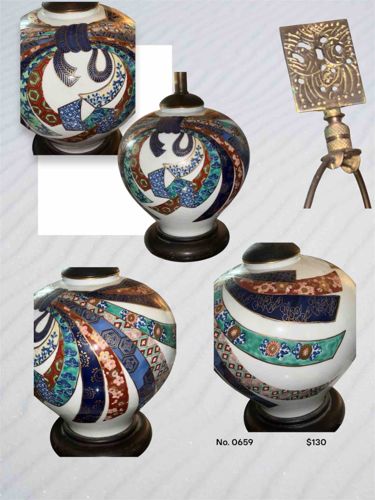
The image displays two ornate Japanese Imari porcelain lamp bases. Both are crafted from high-quality porcelain with a white glaze, serving as the canvas for intricate hand-painted designs. The dominant colors include rich cobalt blue, earthy terracotta/reds, teal, and gold accents. The design features a swirling, ribbon-like motif with sections filled with various traditional Japanese patterns such as florals, geometric shapes, and stylized waves, characteristic of Imari ware. The patterns vary in detail and complexity, indicating skilled craftsmanship. Both lamp bases sit on dark-stained wooden plinths, providing a stable and contrasting base. One lamp base is globular or urn-shaped, tapering slightly at the neck and base, while the other is more polygonal, likely hexagonal or octagonal, with flattened sides. The globular lamp has a brass or bronze-toned fitting at the top, indicating it is prepared for wiring and a lampshade. The polygonal lamp base (labeled 'No. 0659') demonstrates distinct planar surfaces for its decoration. The gold accents, likely applied with real gold, suggest a degree of luxury and fine artistry. There are no obvious visible condition issues such as cracks, chips, or significant repairs from the provided images, though detailed inspection would be required to confirm. The style strongly points to a late 19th or early 20th-century aesthetic, consistent with Meiji or Taisho era Imari production, known for its export quality. The quality of the porcelain and the detailed, multi-colored enamel decoration with gold highlights indicate a higher-end piece of decorative art, intended for functional use as a lamp.
AI Appraisal Report
Based on my visual examination of the provided images, these two Japanese Imari porcelain lamp bases are fine examples of late 19th to early 20th-century production, likely from the Meiji or Taisho era. Both exhibit the characteristic Imari palette of cobalt blue, terracotta/reds, teal, and significant gold accents on a white porcelain ground. The detailed hand-painted designs, including floral motifs, geometric patterns, and stylized waves within swirling ribbon-like sections, demonstrate skilled craftsmanship. The overall condition appears excellent from the images, with no obvious chips, cracks, or significant wear to the enamel or gilding. The varying forms—one globular and the other polygonal—add visual interest. The presence of a dark-stained wooden plinth for stability and a brass-toned fitting on one lamp base confirms their functional intent as lighting fixtures.
Market conditions for antique Japanese Imari porcelain remain steady, with well-preserved and aesthetically pleasing decorator pieces like these finding consistent demand. Comparables in the market for similar high-quality, pre-wired Imari lamp bases often range from $400-$600 each, though exceptional pairs can command higher prices. These pieces are not exceptionally rare, but their quality and apparently good condition enhance their value. The gold accents, if genuine gold, further elevate their desirability.
Limitations in authenticity verification exist given this is an image-based appraisal. A physical inspection would be crucial to confirm the absence of hairline cracks, repairs, or re-gilding which can significantly impact value. Examination under UV light would reveal any restoration. Verification of the gold content would also require a physical assessment. Provenance documentation, such as original purchase receipts or family history, could also enhance valuation. However, based on the clear visual evidence, I assess these lamp bases as authentic and well-preserved examples of Japanese Imari ware, placing them in the decorative arts market as high-quality functioning pieces.