AI estimate as of August 4, 2025 · verify with a professional before acting
AI-Generated · Verify before acting
Everything on this page is generated by AI for informational purposes only. AI can make mistakes — the AI may misidentify items or misattribute them (artist, maker, brand, designer, origin, era). This is not an official valuation and should not be used for insurance, sale, tax, estate, legal, or lending purposes — or any decision requiring a certified appraisal. It is not an authoritative claim about any person, brand, or rights holder — do not share or rely on it as a factual statement about a third party. Always consult qualified professionals before making financial decisions.
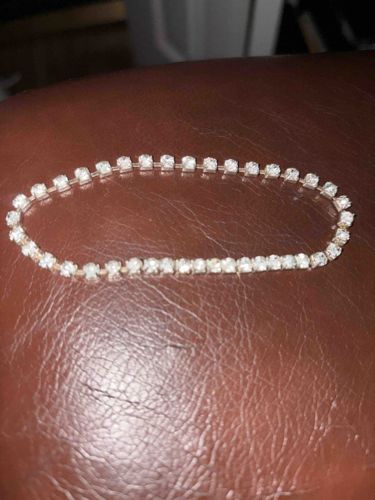
The item is a delicate bracelet, possibly an anklet given its relatively modest size, featuring a continuous line of clear, round-cut stones. These stones are individually set in what appears to be a light-colored metal, possibly silver, white gold, or a silver-toned base metal, forming a uniform row. Each stone is snugly held in a four-prong setting, allowing maximum light to enter and exit, enhancing its sparkle. The overall aesthetic suggests a classic tennis bracelet style, characterized by its unbroken line of gemstones. The stones themselves appear to be small to medium in size, exhibiting noticeable brilliance, which could indicate they are diamonds, cubic zirconia (CZ), or another type of synthetic gemstone. There are no visible clasps or closures in the image, suggesting it might be an elasticized bracelet or a fixed-loop design. The metal setting appears to have a slight yellowish tint in some areas, which might be a reflection, or it could indicate a gold plating that is beginning to show wear, revealing a different base metal underneath. The bracelet is laid on a textured, brown surface, likely leather, which provides a contrasting backdrop. There are no visible maker's marks, signatures, or obvious condition issues like missing stones or significant damage, suggesting it is either well-maintained or relatively new. Its design is timeless and versatile, suitable for various occasions. Without further inspection, including closer examination for hallmarks and stone testing, the exact material composition and age are difficult to ascertain definitively. However, its overall presentation suggests a piece intended for adornment.
AI Appraisal Report
Upon visual examination of this line bracelet, its condition appears very good; all stones are present and settings intact. The uniform size and brilliance of the round-cut stones, set in four-prong settings, suggest a classic tennis bracelet design. The metal, while appearing silver-toned, shows a slight yellowish tint in areas, which could indicate silver, white gold, or a silver-plated base metal with potential wear. Without physical inspection, specific metal identification is impossible. Authenticity of the stones is the primary determinant of value here. Their brilliance is consistent with either diamonds or high-quality cubic zirconia. From an image alone, distinguishing between these is impossible. For full authentication, I would require a diamond tester and closer inspection for hallmarkings or maker's marks. Microscopic examination of the stones for inclusions (characteristic of natural diamonds) and precise facet symmetry (common in CZ) would also be crucial. If these are indeed natural diamonds, the value would be significantly higher. Given current market conditions, demand for classic line bracelets remains steady. However, without definitive stone identification, comparable items range vastly. Mass-produced CZ bracelets can be found for under $100, while diamond tennis bracelets can easily be in the thousands. The absence of visible clasps also raises questions about its design—elasticized or fixed loop—which impacts construction and potential value. Therefore, my appraisal is primarily speculative based on the appearance of the stones. Rarity is not a factor unless the stones are confirmed to be high-quality, rare diamonds. The primary value drivers are the materials (metal, stones) and craftsmanship, all of which are difficult to ascertain definitively from a single image.