AI estimate as of October 13, 2025 · verify with a professional before acting
AI-Generated · Verify before acting
Everything on this page is generated by AI for informational purposes only. AI can make mistakes — the AI may misidentify items or misattribute them (artist, maker, brand, designer, origin, era). This is not an official valuation and should not be used for insurance, sale, tax, estate, legal, or lending purposes — or any decision requiring a certified appraisal. It is not an authoritative claim about any person, brand, or rights holder — do not share or rely on it as a factual statement about a third party. Always consult qualified professionals before making financial decisions.
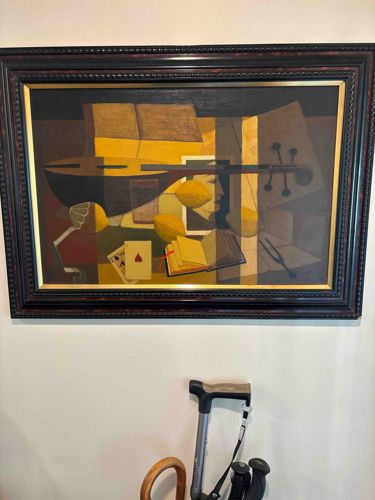
This is a framed oil or acrylic painting executed in a Cubist style, depicting a still life composition. The artwork measures approximately 20-24 inches in height by 30-36 inches in width, based on visual estimation within the frame. The color palette primarily consists of earthy tones including various shades of brown, yellow, mustard, beige, black, and hints of red. The composition features fragmented and geometric representations of objects arranged on what appears to be a tabletop. Observable elements include a stringed instrument, possibly a violin or cello neck and bridge, depicted horizontally across the upper middle section. To the left, a stylized hand appears to be holding a spherical object. In the lower-left quadrant, a playing card, likely an Ace of Hearts, is prominently displayed. Adjacent to it, an open book with red-bound pages lies on the surface, along with several ovoid, yellow objects resembling lemons or other fruit. Other fragmented shapes and planes suggest a complex, multi-perspective view typical of Cubism, with elements overlapping and interpenetrating. The brushwork appears to be visible, suggesting textural qualities on the canvas. The painting is encased in a dark brown, possibly mahogany or stained wood frame, featuring a decorative border with carved or molded patterns and a golden inner fillet accentuating the artwork. There are no visible condition issues such as tears, significant scuffs, or repairs apparent from the image. The frame appears to be in good condition with minor wear consistent with its age. While no specific artist's signature or manufacturing marks are discernible from this image, the style strongly suggests a mid to late 20th-century origin, likely influenced by early 20th-century Cubist masters. The quality of the composition and execution points to a skilled hand, though without a clearer view or signature, specific attribution is difficult.
AI Appraisal Report
Based on my visual examination of the provided image, this Cubist still life painting exhibits excellent compositional strength and skilled execution. The dimensions, estimated at 20-24 inches by 30-36 inches, are a good size for display. The condition of both the painting and its dark brown, decorative frame appears very good, showing no obvious damage like tears, significant scuffs, or repairs. The visible brushwork suggests a textural quality, which adds to its appeal. Stylistically, it strongly aligns with mid to late 20th-century Cubist interpretations, influenced by early 20th-century masters. Elements like the fragmented musical instrument, playing card, open book, and stylized fruit are classic Cubist motifs.
Market conditions for unsigned, yet well-executed, Cubist-inspired works can vary significantly. While a lack of a discernible signature limits the value compared to attributed pieces, the quality of this work suggests it could appeal to collectors of modern art or those seeking decorative pieces with artistic merit. Comparable works by unknown artists in this style typically range from a few hundred to a couple of thousand dollars, depending on size and quality. The demand for well-executed Cubist compositions remains steady, though rarity is not a significant factor here given the likely proliferation of works in this style.
A key factor influencing the current valuation is the absence of an artist's signature or any provenance documentation. Without this, it’s impossible to attribute the work to a known artist, significantly impacting its upper value potential. For a full authentication and higher valuation, an in-person examination would be crucial to inspect brushwork, pigment quality, and search for faint signatures or labels not visible in the image. Additionally, any historical documentation related to the painting’s ownership would be invaluable for establishing provenance.