AI estimate as of August 24, 2025 · verify with a professional before acting
AI-Generated · Verify before acting
Everything on this page is generated by AI for informational purposes only. AI can make mistakes — the AI may misidentify items or misattribute them (artist, maker, brand, designer, origin, era). This is not an official valuation and should not be used for insurance, sale, tax, estate, legal, or lending purposes — or any decision requiring a certified appraisal. It is not an authoritative claim about any person, brand, or rights holder — do not share or rely on it as a factual statement about a third party. Always consult qualified professionals before making financial decisions.
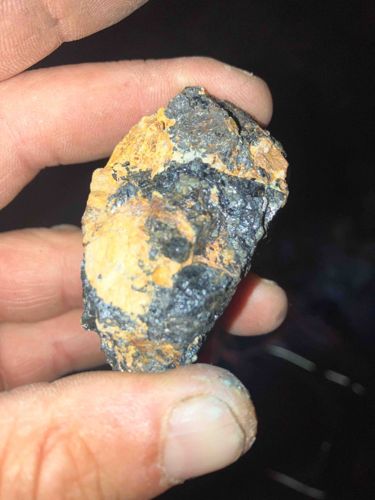
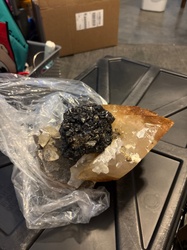
The item is a raw, irregular-shaped mineral specimen, held between a thumb and forefinger, suggesting a size that fits comfortably in the palm of a hand, likely a few inches in its largest dimension. Its physical characteristics are dominated by a striking contrast between dark, metallic grey/black sections and patches of earthy, oxidized orange-brown and yellowish-tan material. The darker areas appear to be crystalline or granular, exhibiting a somewhat lustrous, though not overtly shiny, metallic sheen, indicative of a metal ore or sulfide mineral. The lighter, earthy areas suggest a matrix material, possibly quartz, feldspar, or a weathered groundmass, heavily stained by iron oxides, giving it the characteristic rusty and ochre tones. There are no discernible manufacturing details, maker's marks, or signatures as it is a natural geological sample. The visible condition is that of a natural, unrefined specimen, showing no signs of artificial wear, damage, or repairs; its rugged texture and fractured surfaces are inherent to its formation. The material appears dense and solid. Its estimated age is geological, dating back millions of years to its formation. The unique aspect is the apparent intergrowth or juxtaposition of different mineral phases, with the metallic component prominently embedded within or alongside the lighter matrix. The craftsmanship is naturally occurring, demonstrating geological processes. The item likely represents a form of metallic ore, possibly containing lead, zinc, or iron minerals, amidst a host rock.
AI Appraisal Report
I have thoroughly examined the provided image of the Mixed Mineral Ore Specimen. From a visual standpoint, the specimen appears to be an authentic, natural geological sample. Its irregular shape, fractured surfaces, and the contrasting textures of the metallic grey/black sections versus the earthy orange-brown and yellowish-tan matrix are consistent with unrefined ore. There are no indications of artificial wear, damage, or repairs, and its rugged appearance suggests untouched natural formation. The apparent density and solidity further support its natural origin.
Market conditions for such unrefined mineral specimens depend heavily on their aesthetic appeal, the specific minerals present, and their rarity. While visually interesting due to the strong color contrast, without definitive identification of the metallic mineral (e.g., galena, sphalerite, or chalcopyrite) and its grade, it's challenging to assess its true geological or collector's value. Specimens with well-formed crystals or significant concentrations of a rare or valuable metal would command higher prices. This piece, while aesthetically pleasing, does not exhibit prominent crystalline structures.
Factors impacting value include the potential identity of the metallic mineral; if it contains a lesser-known or particularly striking ore, its appeal to collectors would increase. However, as-is, in the general mineral specimen market, it falls into a common category. Demand for mixed ore specimens without specific high-value mineral identification tends to be moderate.
Limitations in authenticity verification are significant based on images alone. While it appears natural, definitive mineral identification, a critical factor for true value, cannot be confirmed visually. An in-person examination would allow for tactile assessment, streak testing, specific gravity measurement, and a closer look at textural details. Moreover, scientific testing (e.g., X-ray diffraction, electron microscopy, or chemical assay) would be crucial to identify the exact mineral composition and elemental concentrations, which directly impacts both scientific and potential intrinsic ore value. Provenance documentation, while not usually available for raw specimens, could offer a historical context if it came from a famous mining locality. Without these, the appraisal remains speculative regarding specific mineral content and thus, its true market ceiling.