AI identification & appraisal estimate

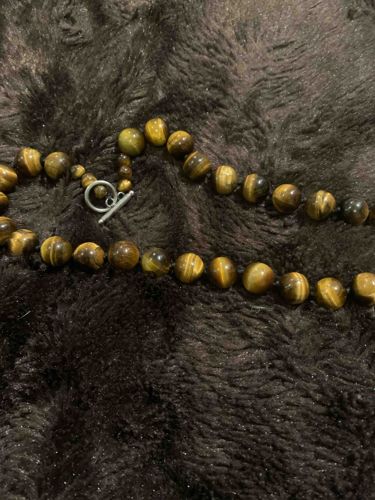
Tiger's Eye Beaded Necklace

Submitted photo of Tiger's Eye Beaded Necklace
Photo submitted by the user — not generated by AI

User's notes

Stone

These notes were written by the person who submitted this item. Appraiser.AI has not verified them, and the AI's identification and estimate may rely on them.

AI Estimated Value

Not an official valuation

$30-50

AI estimate as of July 7, 2025 · verify with a professional before acting

AI-Generated · Verify before acting

Everything on this page is generated by AI for informational purposes only. AI can make mistakes — the AI may misidentify items or misattribute them (artist, maker, brand, designer, origin, era). This is not an official valuation and should not be used for insurance, sale, tax, estate, legal, or lending purposes — or any decision requiring a certified appraisal. It is not an authoritative claim about any person, brand, or rights holder — do not share or rely on it as a factual statement about a third party. Always consult qualified professionals before making financial decisions.

This analysis also relies on unverified notes provided by the user, which may be incomplete or inaccurate and could affect the result.

Read the full disclaimer

AI Item Analysis

This item is a necklace composed of spherical, polished beads of what appears to be Tiger's Eye stone. The beads exhibit the characteristic chatoyancy (cat's eye effect) associated with Tiger's Eye, showing varying shades of golden brown, yellow, and darker brown stripes that shift as light reflects off the surface. Each bead is relatively uniform in size, suggesting machine cutting and polishing, with an approximate diameter between 8mm and 12mm. The stringing material is not clearly visible, but the beads are strung closely together to form a continuous strand. The necklace features a silver-toned metal toggle clasp mechanism for closure, consisting of a ring and a bar. The metal of the clasp appears to be a base metal or a silver alloy, showing no visible signs of significant tarnish or wear. The overall condition of the necklace seems good, with no obvious chips or cracks in the beads and the polish intact. The natural variations in the tiger's eye pattern contribute to the unique appearance of each bead, indicating genuine stone rather than a synthetic material. The craftsmanship appears to be standard for commercially produced beaded jewelry, focusing on the natural beauty of the stones. The design is simple and classic, suggesting a relatively modern production, likely from the late 20th to early 21st century. No maker's marks or signatures are discernible on the clasp or beads.
AI Appraisal Report

Based on my visual examination of the provided image and given details, this Tiger's Eye beaded necklace appears to be in good overall condition. The characteristic chatoyancy and color variations strongly suggest genuine Tiger's Eye stone. The uniform bead size (8mm-12mm) points to commercial production. The silver-toned clasp suggests base metal or a common silver alloy, not sterling, given the lack of hallmarking. This type of jewelry, while attractive, is mass-produced. Market conditions for beaded gemstone necklaces are generally stable but not highly lucrative. Comparables for genuine Tiger's Eye necklaces of this style typically range from $20 to $60 USD, depending on bead quality, size, and findings. There is no significant rarity associated with common Tiger's Eye beads of this size and quality, nor is there exceptionally high demand for new examples. Factors impacting value include the natural beauty of the stone, its good condition, and the simple, classic design. The lack of maker's marks or unique design elements keeps the value in the everyday jewelry range. A significant limitation is that authentication is based on visual cues alone. A full in-person examination would allow for precise measurement of beads, closer inspection of the stringing material for durability, and a definitive test of the metal clasp (e.g., acid testing for silver content if a sterling mark is suspected but not seen). While the beads appear genuine, scientific testing could confirm stone authenticity and rule out very high-quality imitations, though this is rarely done for lower-value items. Provenance documentation, if available, could offer insights into its origin, but is not typically expected for this type of item.

Keep exploring

More jewelry appraisals

Get your items appraised

Instant AI-powered appraisal estimates from a photo

Browse More Appraisals