AI estimate as of November 6, 2025 · verify with a professional before acting
AI-Generated · Verify before acting
Everything on this page is generated by AI for informational purposes only. AI can make mistakes — the AI may misidentify items or misattribute them (artist, maker, brand, designer, origin, era). This is not an official valuation and should not be used for insurance, sale, tax, estate, legal, or lending purposes — or any decision requiring a certified appraisal. It is not an authoritative claim about any person, brand, or rights holder — do not share or rely on it as a factual statement about a third party. Always consult qualified professionals before making financial decisions.
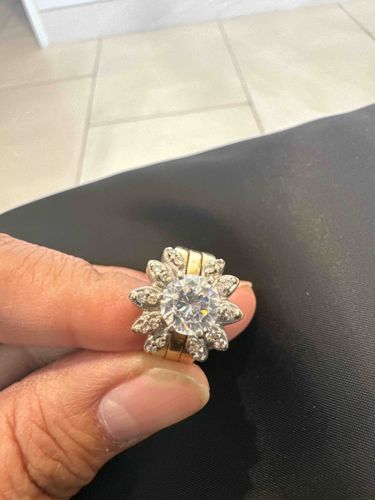
This item is a decorative finger ring, featuring a prominent floral cluster design. The ring appears to be constructed with two distinct metal tones: a wider band portion in a yellow-gold color and the top cluster setting in a silver or white gold tone. The central element of the cluster is a large, round, brilliant-cut clear stone, which, based on visual assessment and common jewelry practices for this style, is likely a cubic zirconia or a similar synthetic diamond simulant. The central stone is surrounded by a halo of smaller, round, clear stones, also likely cubic zirconia, arranged in a petal-like or daisy pattern, creating the 'floral' aesthetic. There are eight distinct 'petals,' each set with two smaller stones, totaling sixteen accent stones around the central one. The setting style for the smaller stones appears to be prong-set, securing each stone individually. The overall construction suggests a multi-part assembly, with the upper cluster setting mounted atop the wider, yellow-toned band. The band itself appears polished and relatively thick, contributing to the ring's overall presence. The stones exhibit good clarity and sparkle, typical of well-cut diamond simulants. There are no visible manufacturer's marks or stamps in the provided image. The ring appears to be in good condition with no obvious chips, cracks, or significant abrasions on the stones, and the metal shows a polished finish with minor surface wear consistent with gentle use. This design is quite popular and could date anywhere from the late 20th century to contemporary times, possibly indicating a fashion or costume jewelry piece given the likely use of simulants and two-tone base metals. Craftsmanship appears to be machine-made or mass-produced given the uniform setting of the stones, but the arrangement is aesthetically pleasing and visually impactful.
AI Appraisal Report
I have examined the provided image of this Two-Tone Floral Cluster Ring. The ring showcases a prominent floral cluster design, featuring a large central clear stone surrounded by a halo of smaller clear stones in a petal-like arrangement, creating a daisy motif. The two-tone aesthetic, with a yellow-gold toned band and a silver-toned cluster setting, is a common design choice in fashion jewelry. Based on the visual characteristics, including clarity, brilliance, and the lack of visible inclusions, coupled with the commonality of such designs, the stones are almost certainly cubic zirconia or similar diamond simulants, not natural diamonds. The metal tones suggest a base metal construction, possibly rhodium-plated brass or silver for the white tone, and gold-plated for the yellow tone, rather than solid gold or platinum. The ring appears to be in good condition with minor surface wear consistent with gentle use; stones are intact and shiny, and the metal retains its polish.
Market comparables for similar new or used fashion jewelry pieces with cubic zirconia and plated finishes typically range from $30 to $150, depending on brand and specific design. This item's appeal lies in its decorative aesthetics rather than intrinsic material value. Demand for such a design is consistent; however, rarity is low due to mass production. Factors significantly impacting value are the use of simulants and base metals, which inherently keep the value modest.
It is crucial to state that this appraisal is based solely on visual examination of the provided image. Without a physical inspection, I cannot confirm the exact composition of the metals (e.g., gold plating thickness, base metal type) or definitively identify the stone material through scientific testing (e.g., diamond tester, refractometer). An in-person examination would also be necessary to check for hidden marks, assess structural integrity more thoroughly, and confirm stone settings definitively. Provenance documentation would offer insight into its origin or brand, which could potentially affect value if it were from a noted designer, though this is unlikely for a piece of this type.