AI estimate as of November 22, 2025 · verify with a professional before acting
AI-Generated · Verify before acting
Everything on this page is generated by AI for informational purposes only. AI can make mistakes — the AI may misidentify items or misattribute them (artist, maker, brand, designer, origin, era). This is not an official valuation and should not be used for insurance, sale, tax, estate, legal, or lending purposes — or any decision requiring a certified appraisal. It is not an authoritative claim about any person, brand, or rights holder — do not share or rely on it as a factual statement about a third party. Always consult qualified professionals before making financial decisions.
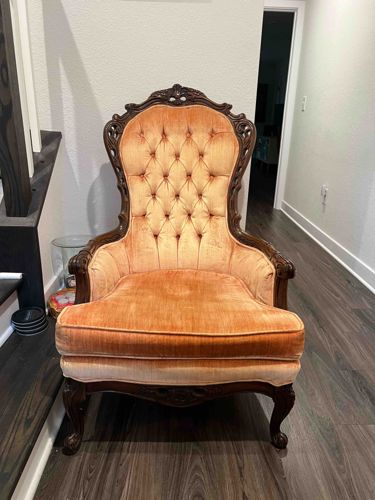
This is a Victorian-style armchair, characterized by its elaborately carved dark wood frame and plush, tufted upholstery in a warm peach or faded orange-brown velvet-like fabric. The chair features a high, ornately shaped backrest with continuous carving along its scrolled top and side edges, extending to the arms. The armrests are also carved, featuring gentle curves and decorative flourishes at their junction with the seat. The seat cushion is wide and appears removable or semi-attached, covered in the same velvet-like material. The backrest is deep-button tufted, creating a classic diamond pattern that adds to its luxurious appearance. The chair stands on four cabriole legs, with the front legs exhibiting more detailed carving and a scroll motif near the foot, while the rear legs are simpler. There is also carved detailing along the apron beneath the seat. The wood frame exhibits a rich, dark finish, possibly mahogany or a similarly dark-stained hardwood, showing some wear consistent with age, particularly on edges and raised carved areas where the lighter wood might peek through or the finish has thinned. The upholstery material appears generally clean but shows some compression marks and possibly slight discoloration or fading indicative of age and use, especially on the seat cushion. The overall condition suggests it is an antique or a well-preserved vintage piece, possibly from the late 19th or early 20th century, embodying the rococo revival or Victorian aesthetic.
AI Appraisal Report
Based on my visual examination of the provided image, this Victorian-style tufted armchair is an attractive example of Rococo Revival furniture, likely dating from the late 19th to early 20th century. The elaborate carved dark wood frame, featuring scrolled tops, carved armrests, and decorative cabriole legs, is consistent with the period. The deep-button tufted, peach/faded orange-brown velvet-like upholstery adds to its authentic Victorian aesthetic.
From the image, the condition appears good for its age. The dark wood finish shows expected wear on edges and raised carved areas, which is typical for an antique and adds to its character rather than detracting significantly from value. The upholstery, while generally clean, exhibits compression marks and some possible fading or discoloration consistent with age and use. These are minor condition issues that do not drastically reduce its marketability but reflect a well-loved piece.
Market conditions for Victorian furniture are steady but not soaring. While there is a consistent demand for well-preserved, ornate pieces, the market is not experiencing rapid appreciation. Comparable armchairs of this quality and condition typically sell in the $400-$700 range. Rarity is not a major factor here, as similar Victorian armchairs were produced in considerable numbers. The overall aesthetic appeal, condition, and decorative qualities are the primary drivers of value.
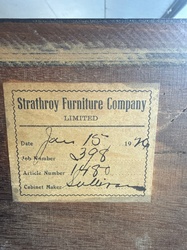
It is important to note the limitations of appraising from an image alone. Without an in-person examination, I cannot definitively verify the wood type, the exact condition of the frame's joints, or the interior condition of the upholstery (e.g., spring integrity). Full authentication of its age would ideally involve examining construction techniques, original labels (if any), and assessing the patina more closely. Provenance documentation or scientific testing of materials would further solidify its authenticity and precise age, which could potentially influence value, though likely within the estimated range.