These notes were written by the person who submitted this item. Appraiser.AI has not verified them, and the AI's identification and estimate may rely on them.
AI Estimated Value
Not an official valuation
$400 - $800
AI estimate as of December 5, 2025 · verify with a professional before acting
AI-Generated · Verify before acting
Everything on this page is generated by AI for informational purposes only. AI can make mistakes — the AI may misidentify items or misattribute them (artist, maker, brand, designer, origin, era). This is not an official valuation and should not be used for insurance, sale, tax, estate, legal, or lending purposes — or any decision requiring a certified appraisal. It is not an authoritative claim about any person, brand, or rights holder — do not share or rely on it as a factual statement about a third party. Always consult qualified professionals before making financial decisions.
This analysis also relies on unverified notes provided by the user, which may be incomplete or inaccurate and could affect the result.
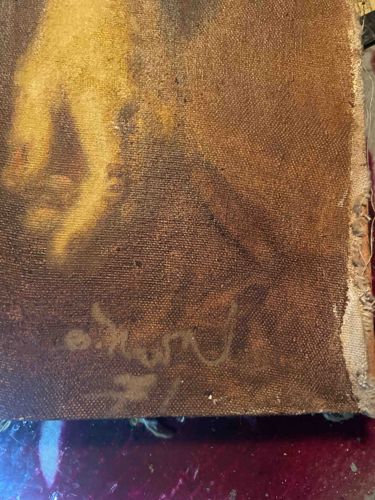
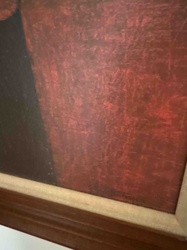
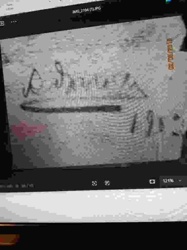
This item is a close-up image of a section of what appears to be a large-scale oil painting on canvas. The primary visible physical characteristics include a woven canvas material, likely linen or cotton, exhibiting a distinct texture. The color palette in the visible section is dominated by earthy tones, predominantly browns, dark ochres, and muted yellows, creating a sense of depth and perhaps depicting a figure or form in light against a darker background. The brushstrokes, though not entirely clear, suggest a broader application of paint typical of oil work, with some areas appearing more impasto. A crucial distinguishing element is a signature or inscription located in the lower left quadrant of the visible fragment. While difficult to decipher with absolute certainty from this image, the letters appear to spell out 'Monet' or a similar-looking script, consistent with the provided context of a 'Monet painting'. The overall condition shows signs of age and wear. The canvas edges are frayed, suggesting this might be a cut-down section of a larger artwork, or perhaps the edge of an unframed work. There is noticeable surface grime, dust, and possibly some small accretions, indicating a lack of recent conservation or cleaning. The canvas weave itself appears stable, but the presence of dark spots and uneven color distribution could point to degradation of the paint layers or localized damage. Without an overall view, precise age determination is challenging, but the visible characteristics and potential signature point towards an artwork from the late 19th or early 20th century, consistent with the Impressionist period. The craftsmanship appears to be professional, evidenced by the consistent canvas weave and the technique suggested by the visible areas, although the fragmented nature limits a full assessment of overall quality. The primary uniqueness lies in the potential attribution to a renowned artist, which would significantly impact its value and historical importance.
AI Appraisal Report
Upon examining the images provided for this fragment of an oil painting on canvas, my assessment must remain preliminary. The piece presents as a cut-down section of a larger work, displaying earthy tones and brushwork somewhat reminiscent of the Impressionist period. The paramount feature is the signature in the lower left quadrant, which bears a resemblance to that of Claude Monet. However, I must state unequivocally that authentication based on a digital image and a purported signature is impossible. Forged signatures are common, and stylistic mimicry can be deceptive.
The item's condition is fair to poor; the canvas is frayed, and there is visible surface grime and potential degradation of the paint layer. As a fragment, its aesthetic and compositional integrity is completely lost, which severely diminishes its value, even if it were genuine. A genuine, but partial, signature from a major artist adds intellectual interest but not significant market value without the accompanying artwork.
The current market for authenticated works by Monet is exceptionally strong, with major paintings selling for tens of millions of dollars. However, the market for attributed fragments is virtually non-existent. Its value is primarily as a decorative or curiosity piece. A potential buyer would be acquiring it on a speculative basis. For a definitive appraisal, physical examination is essential. This would involve microscopic analysis of the paint, canvas, and signature, UV light examination, and pigment analysis. Crucially, a full authentication would require extensive provenance research to trace the fragment back to a known Monet painting, perhaps one that was documented as being damaged or cut down. Without such rigorous verification, the piece must be appraised as 'in the style of' or 'bearing a signature of,' not as an authentic work. My valuation reflects its status as an unauthenticated, decorative fragment with academic interest only.