AI estimate as of September 27, 2025 · verify with a professional before acting
AI-Generated · Verify before acting
Everything on this page is generated by AI for informational purposes only. AI can make mistakes — the AI may misidentify items or misattribute them (artist, maker, brand, designer, origin, era). This is not an official valuation and should not be used for insurance, sale, tax, estate, legal, or lending purposes — or any decision requiring a certified appraisal. It is not an authoritative claim about any person, brand, or rights holder — do not share or rely on it as a factual statement about a third party. Always consult qualified professionals before making financial decisions.
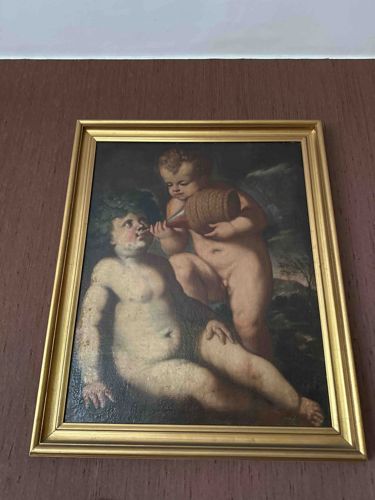
This is an oil painting depicting two putti, or cherubic figures, in a landscape setting. The painting features rich, dark tones typical of Old Master works. One putto, positioned in the foreground and slightly to the left, is reclined with a robust, fleshy physique, its left elbow propped up and its right arm resting on its leg. Its gaze is directed upwards towards the second putto. The second putto stands behind and to the right, also with a full figure, holding a woven or wicker flask or bottle and seemingly pouring or offering a drink to the reclining figure. The skin tones of the putti are rendered in warm, naturalistic hues with visible brushstrokes suggesting the texture of flesh. The background is dark and indistinct, with hints of a landscape, possibly foliage or rocky terrain, rendered in muted greens and browns, creating a chiaroscuro effect that highlights the figures. The overall composition suggests an allegorical or mythological theme, perhaps related to sustenance or abundance, or even a Bacchic scene. The painting is encased in a simple, but elegant, gilded wooden frame with a classic ogee profile. Visible condition issues include some surface dirt and possible yellowing of the varnish, which is common in older oil paintings, and some minor abrasions to the frame. The brushwork appears confident and expressive, indicative of a trained artist, though no specific artist's signature or markings are discernible from the image. The style and subject matter suggest a European origin, likely from the Baroque or Rococo period, possibly 17th or 18th century, though a later imitation cannot be entirely ruled out without further inspection. The quality of the execution, particularly in the rendering of anatomy and emotion, appears to be of a good standard.
AI Appraisal Report
Based on my visual examination of the image provided, this oil painting depicting two putti with a flask presents as a compelling piece, likely from the Baroque or Rococo period (17th-18th century) given its style and subject matter, though a later imitation is a possibility without further inspection. The rich, dark tones and chiaroscuro effect are characteristic of Old Master works. The figures' warm, naturalistic skin tones and confident brushwork suggest a trained artist. The composition hints at allegorical or mythological themes.
Condition-wise, I observe surface dirt, probable varnish yellowing, and minor frame abrasions, all common for paintings of this age. These issues, while impacting immediate display quality, are generally restorable.
Market conditions for unsigned works of this period can be variable, but well-executed putti scenes with good aesthetic appeal do hold collector interest. Demand for such pieces is steady, particularly if the quality of execution is high, as it appears to be here. The lack of a discernible artist's signature significantly impacts its value, preventing it from reaching prices associated with attributed masters.
The primary limitation to a definitive appraisal is the inability to conduct an in-person physical examination. Without this, I cannot confirm authenticity with certainty. A full authentication would require examining the stretcher, canvas, and paint layers for age and technique consistency, perhaps through UV light inspection or micro-analysis. Provenance documentation would also be crucial. For these reasons, my valuation places it as a good quality period piece, but not one by a known master, at this juncture.