AI estimate as of July 15, 2025 · verify with a professional before acting
AI-Generated · Verify before acting
Everything on this page is generated by AI for informational purposes only. AI can make mistakes — the AI may misidentify items or misattribute them (artist, maker, brand, designer, origin, era). This is not an official valuation and should not be used for insurance, sale, tax, estate, legal, or lending purposes — or any decision requiring a certified appraisal. It is not an authoritative claim about any person, brand, or rights holder — do not share or rely on it as a factual statement about a third party. Always consult qualified professionals before making financial decisions.
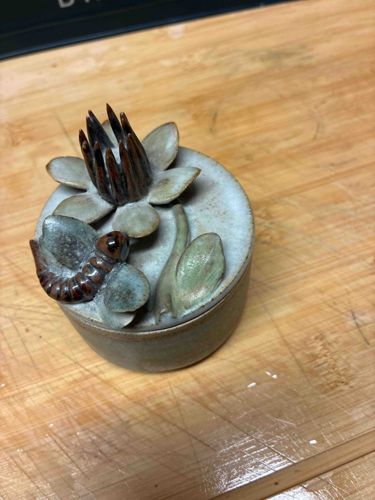
This is a small, ornate lidded box, likely crafted from ceramic or stoneware given its earthy, matte finish and irregular textures. The dominant color palette features muted tones, primarily a grayish-brown for the base and lid, complemented by a richer, reddish-brown for the central floral element and the body of the insect, and subtle greenish-grey accents on the leaves and insect wings. The box appears to be cylindrical or softly rounded in shape, topped with a fitted lid. The lid is the most decorative part, featuring three-dimensional applied elements. In the center, there is a prominent floral motif resembling a blooming lotus or water lily, with multiple petals in a lighter, off-white or light gray tone, and a darker, almost spiky central pistil structure. To the left of the flower, a detailed insect, possibly a beetle or a stylized fly, is depicted with a segmented, reddish-brown body and grayish-green wings that show some textural detail. There's also a leaf-like element near the insect. The construction suggests hand-modeling, giving it an organic and unique character. The surface exhibits a slightly speckled or textured glaze, contributing to its rustic appeal. There are no immediately visible signs of significant damage like chips or cracks; the slight variations in color and texture appear to be intentional as part of the craftsmanship. The overall aesthetic points to a handcrafted, possibly artisan-made piece from the late 20th century or early 21st century, designed for decorative purposes or for holding small trinkets. The craftsmanship suggests a folk art or studio pottery influence, with attention to detail in the sculptural elements.
AI Appraisal Report
Upon examining the provided image of this Ceramic Lidded Trinket Box with Floral and Insect Motif, I assess its condition to be excellent. The piece displays no visible chips, cracks, or significant abrasions. The textural variations and color nuances appear to be intentional aspects of its handcrafted nature rather than damage. Authenticity, based solely on visual inspection, points to a genuine artisan or studio pottery piece. The hand-modeled elements and rustic glaze suggest individual creation rather than mass production.
Regarding market conditions, pieces of this type, often categorized under studio pottery, folk art, or decorative ceramics, currently enjoy a steady but not exceptionally high demand. Their value is largely driven by artistic merit, uniqueness, and the maker's reputation if known. Without a discernible maker's mark or provenance, this piece enters the market as an unsigned work. Comparables would include similar handcrafted ceramic boxes found in artisan markets, online craft platforms, or smaller antique/collectible shops specializing in decorative arts. While unique, it's not exceptionally rare within the broader category of small decorative containers. Factors significantly impacting its value include its excellent condition, the appealing sculptural elements, and its aesthetic as a decorative object. However, the lack of artist identification limits its potential for higher valuation typically associated with renowned potters or specific art movements.
It is crucial to state that this appraisal is based purely on visual inspection of the image. For full authentication, an in-person examination would be necessary to assess tactile qualities, precise weight, and thoroughly search for subtle maker's marks that might be obscured or too small to see in the photograph. Provenance documentation, such as purchase records or exhibition history, if available, would further enhance authentication and value. Scientific testing, like material analysis, is generally not warranted for items of this nature unless there are specific doubts about the ceramic composition or age. Without further information or physical inspection, the value remains an estimate based on its decorative appeal and apparent craftsmanship.