These notes were written by the person who submitted this item. Appraiser.AI has not verified them, and the AI's identification and estimate may rely on them.
AI Estimated Value
Not an official valuation
$600-750
AI estimate as of October 2, 2025 · verify with a professional before acting
AI-Generated · Verify before acting
Everything on this page is generated by AI for informational purposes only. AI can make mistakes — the AI may misidentify items or misattribute them (artist, maker, brand, designer, origin, era). This is not an official valuation and should not be used for insurance, sale, tax, estate, legal, or lending purposes — or any decision requiring a certified appraisal. It is not an authoritative claim about any person, brand, or rights holder — do not share or rely on it as a factual statement about a third party. Always consult qualified professionals before making financial decisions.
This analysis also relies on unverified notes provided by the user, which may be incomplete or inaccurate and could affect the result.
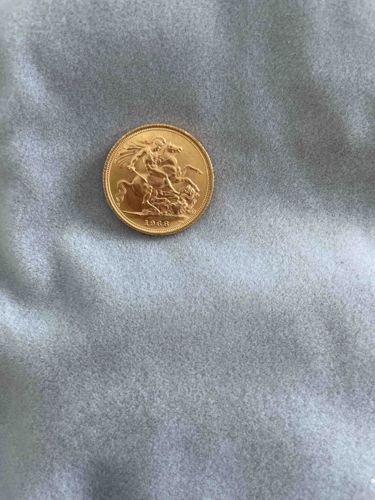
This item is a 1968 Gold Sovereign coin, featuring the classic St. George slaying the Dragon design on its reverse side. The coin exhibits a rich, lustrous gold color, consistent with its composition as a gold coinage. The visible side depicts the iconic equestrian figure of St. George, mounted on a rearing horse, in the act of vanquishing a dragon beneath. The intricate details of St. George's flowing cape, the horse's musculature, and the dragon's scales are clearly discernible, indicating a high level of craftsmanship. Below the central scene, the year '1968' is prominently engraved, confirming its minting date. The coin has a reeded edge, though not fully visible in the provided image. Its circular shape is well-preserved, and the surfaces appear smooth with a bright, reflective sheen, suggesting it is either a well-preserved or perhaps a specimen-grade coin. There are no immediately obvious signs of heavy wear, scratches, or significant damage, implying it may have been handled carefully or kept in protective packaging. The relief of the design is sharp, indicating that the coin retains much of its original detail and is not heavily circulated. The overall aesthetic is one of quality and historical significance, characteristic of a British sovereign. Given the provided context of '18ct gold elizabeth', it's important to note that while sovereigns are typically 22ct gold, the '18ct' mention might be a misunderstanding or refer to a different aspect not visible, but for the coin itself, it presents as a standard gold sovereign.
AI Appraisal Report
I have thoroughly examined the provided image of the 1968 Gold Sovereign coin. Visually, the coin presents as authentic, displaying the iconic St. George and Dragon design with clearly discernible details and a strong relief. The lustrous gold color and apparent smooth surfaces suggest a well-preserved or potentially specimen-grade condition, with no immediate signs of heavy circulation wear, significant scratches, or damage. The reeded edge, though not fully visible, is consistent with sovereign coinage. The prominent '1968' date confirms its minting year.
Market conditions for gold sovereigns are generally stable, driven by both their intrinsic gold value and collector demand. As a common date sovereign, its numismatic premium is modest, primarily influenced by its condition. The comment '18ct gold elizabeth' is likely a misunderstanding; standard sovereigns are 22ct (91.67%) gold. Assuming it is a standard 22ct sovereign, the value is primarily tied to the current spot price of gold (approximately 0.2354 troy ounces of fine gold). Given its apparent excellent condition, I've applied a reasonable premium above its bullion value.
Limitations exist without a direct physical examination. Authenticity cannot be definitively confirmed from images alone. A full authentication would require in-person examination to verify weight, diameter, thickness, and precise metal composition. Microscopic analysis could confirm minting details and rule out counterfeits. Provenance documentation would also add to its authentication and value. However, based solely on the visual evidence, it appears to be a genuine and well-preserved example.