AI estimate as of August 14, 2025 · verify with a professional before acting
AI-Generated · Verify before acting
Everything on this page is generated by AI for informational purposes only. AI can make mistakes — the AI may misidentify items or misattribute them (artist, maker, brand, designer, origin, era). This is not an official valuation and should not be used for insurance, sale, tax, estate, legal, or lending purposes — or any decision requiring a certified appraisal. It is not an authoritative claim about any person, brand, or rights holder — do not share or rely on it as a factual statement about a third party. Always consult qualified professionals before making financial decisions.
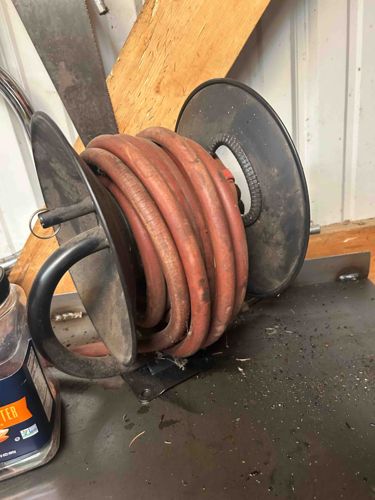
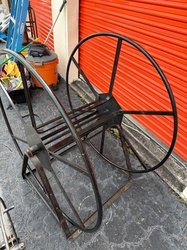
The item is a manually operated hose reel, designed to store and dispense a coiled hose. It appears to be constructed primarily of metal, likely steel, given its robust appearance and the welding marks visible. The main components consist of two circular flanges, approximately 10-12 inches in diameter, which form the sides of the reel, and a cylindrical core around which the hose is wound. The color of the metal components is a dark, possibly matte black or very dark grey, consistent with a utilitarian finish often found on workshop or industrial equipment. There are visible signs of welding on the flange where the cylindrical core attaches, indicating a fabricated construction. A black, curved handle, also likely metal, is attached to one side of the reel, presumably for winding the hose. The handle shows some scuffing and minor wear. The reel is mounted on a flat, black metal base plate, suggesting it is designed for stationary use, possibly bolted to a workbench or floor. There are mounting holes visible on this base plate. The hose itself is a distinctly reddish-orange color, likely made of rubber or a synthetic polymer, and appears somewhat stiff and heavily used, showing grime, discoloration, and scuff marks along its length, indicating significant exposure to dirty environments or outdoor conditions. The overall condition suggests a functional item that has seen considerable wear and tear, but still appears to be intact and operational. There are no visible maker's marks or distinct brand identifiers. The style is purely functional and industrial, lacking any decorative elements, indicating a focus on utility over aesthetics. The age is difficult to pinpoint without more specific markings, but the traditional design and materials suggest it could be several decades old, or a modern reproduction in a classic utility style.
AI Appraisal Report
I have examined the provided image of this manual hose reel with a red hose. My assessment indicates a robust, utilitarian piece of equipment, likely constructed from steel given its appearance and visible welding marks. The dark color scheme points to a functional, possibly industrial, background. The red hose itself shows considerable signs of heavy use, including grime, scuffing, and discoloration, suggesting it has been frequently employed in demanding environments. This wear considerably impacts its aesthetic value, placing it firmly in the 'used' condition category. Authenticity, based solely on this image, appears straightforward; it presents as a genuine, factory-fabricated hose reel. However, without in-person examination, I cannot confirm specific material grades or the exact manufacturing process with absolute certainty. Factors influencing value include its functional condition, which appears intact, but also its well-worn appearance. Market conditions for used utilitarian equipment like this are generally steady but not high. It's a common item, lacking rarity. Comparables would include other used manual hose reels found at industrial supply liquidators, online marketplaces, or farm/garage sales, typically ranging from basic to medium-duty. Higher-end, specialized, or antique reels would command more, but this item does not fit those categories. The absence of maker's marks or unique identifiers also limits its appeal as a collectible. For full authentication, I would ideally need a physical inspection to check for internal structural integrity, precise measurements, and material composition analysis. Provenance documentation, such as original purchase receipts or manifest lists from an industrial setting, would also be beneficial but are unlikely for an item of this nature. Scientific testing is unwarranted for such an item.