AI estimate as of October 10, 2025 · verify with a professional before acting
AI-Generated · Verify before acting
Everything on this page is generated by AI for informational purposes only. AI can make mistakes — the AI may misidentify items or misattribute them (artist, maker, brand, designer, origin, era). This is not an official valuation and should not be used for insurance, sale, tax, estate, legal, or lending purposes — or any decision requiring a certified appraisal. It is not an authoritative claim about any person, brand, or rights holder — do not share or rely on it as a factual statement about a third party. Always consult qualified professionals before making financial decisions.
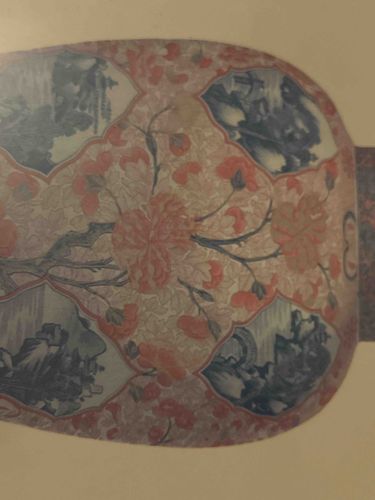
This item appears to be a decorative panel or a section of a larger decorative covering, possibly wallpaper or a textile, featuring a central design of vibrant floral motifs interspersed with cartouches depicting landscape scenes. The overall shape of the visible section is convex, suggesting it might be part of an architectural detail like a ceiling medallion, a wall frieze, or a decorative screen. The dominant colors in the floral sections are shades of red and coral for the blossoms, with darker, possibly brown or black, branches and stems, set against a lighter, textured background that appears to be cream or beige. The texture of the background hints at a fabric or a finely patterned paper. The cartouches are rendered in a distinct blue-and-white style, reminiscent of traditional Chinese porcelain or watercolor paintings, showcasing detailed natural scenes with mountains, trees, and possibly water features or structures. The edges of these cartouches are outlined in a reddish-brown color, echoing the floral palette. The craftsmanship appears to be intricate, with fine details in both the floral elements and the miniature landscape illustrations. There are no immediate visible signs of major damage or wear, though the overall image quality makes it difficult to assess fine details such as cracks, fading, or repairs. The style suggests an East Asian influence, possibly Chinese or Japanese, and could date from the late 19th century to the mid-20th century, given its aesthetic. The quality of the design indicates a well-executed decorative piece intended for an elegant interior.
AI Appraisal Report
This Asian-Style Floral and Landscape Decorative Panel appears to be a section of a larger decorative covering, likely wallpaper or a textile, given its convex shape suggesting architectural integration. Visually, the condition appears good, with vibrant colors in the floral motifs and distinct blue-and-white landscape cartouches. I observe no immediate signs of significant damage such as tears, major fading, or repairs, though a detailed assessment of such fine details is limited by image quality.
Authenticity, based purely on imagery, appears consistent with late 19th to mid-20th century East Asian decorative arts, showing good craftsmanship. The style exhibits common aesthetic elements of the period suitable for elegant interiors. However, definitive authentication (material composition, age verification) would require in-person examination, including tactile assessment of texture, observation under varying light conditions, and potentially microscopic analysis of pigments or fibers. Provenance documentation, such as manufacturing marks or history of ownership, would also be crucial.
Market conditions for such decorative panels are moderately stable. Comparables would include antique decorative wallpapers, textile fragments, or architectural friezes with similar Asian motifs. While decorative, this piece isn't overtly rare; similar items appear periodically in auctions and decorative arts sales. Demand is primarily from collectors of Asian decorative arts or interior designers seeking period-appropriate embellishments. Factors impacting value include its good visual condition, intricate design, and aesthetic appeal. The main limitation without physical inspection is the inability to confirm material integrity, true age, or identify undocumented restorations. My valuation is thus conservative, reflecting these limitations and the typically moderate market for such decorative fragments.