AI estimate as of July 19, 2025 · verify with a professional before acting
AI-Generated · Verify before acting
Everything on this page is generated by AI for informational purposes only. AI can make mistakes — the AI may misidentify items or misattribute them (artist, maker, brand, designer, origin, era). This is not an official valuation and should not be used for insurance, sale, tax, estate, legal, or lending purposes — or any decision requiring a certified appraisal. It is not an authoritative claim about any person, brand, or rights holder — do not share or rely on it as a factual statement about a third party. Always consult qualified professionals before making financial decisions.
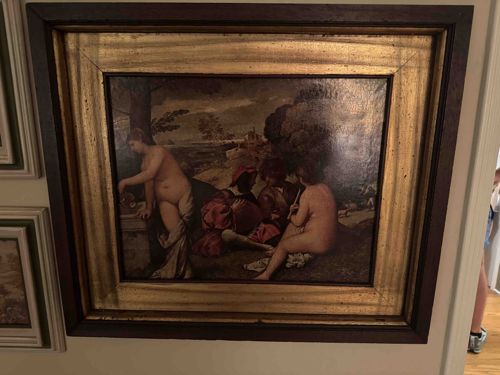
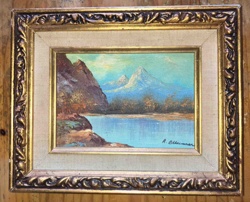
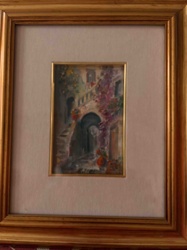
The item is a framed oil painting, likely on canvas or panel, depicting a classical or mythological scene with nude figures in a landscape. The artwork is housed within a substantial wooden frame that appears to be stained a dark, rich brown or black, with a prominent gilded inner liner. This inner liner shows signs of wear and possibly some chipping or flaking of the gilt finish, particularly visible in the upper right and left corners, suggesting age and handling. The painting itself exhibits a subdued color palette, typical of older works, with earthy greens, browns, and muted reds dominating the landscape and figures. There appear to be at least three figures. One nude female figure is on the left, seemingly interacting with a pedestal or fountain structure. In the center, a figure in richly colored red and brown drapery is seated, possibly playing a musical instrument or engaged in conversation. Another nude figure, possibly female, is seated on the right. The brushwork, while not clearly discernible in detail due to resolution, appears to be traditional with some visible texture, indicating it's not a print. The surface of the painting shows significant craquelure, a network of fine cracks in the paint layer, which is common in older oil paintings and suggests a considerable age, likely 19th century or earlier. There may also be some darkening or yellowing of the varnish layer, further contributing to the aged appearance. No specific artist's signature or maker's marks are visible in the provided image. The overall condition suggests a vintage or antique piece that has experienced natural aging and some wear to its frame.
AI Appraisal Report
Based on my visual examination of the provided image, this framed oil painting, depicting a Classical/Mythological Landscape with Figures, appears to be an authentic antique piece. The significant craquelure, subdued color palette, and apparent darkening of the varnish layer are consistent with an oil painting from the 19th century or possibly earlier. The wooden frame, with its dark stain and gilded inner liner, also aligns with this period, though the wear and chipping on the gilt suggest age and handling.
The condition of the painting itself, with visible craquelure, is typical for an oil work of this age and does not necessarily detract from its value unless there are major losses or structural issues not visible in the image. The frame exhibits wear, which is expected. The lack of a visible signature is common for works of this period, and its absence alone does not invalidate authenticity, but it does make attribution challenging.
Factors impacting value include the lack of a known artist, which prevents it from entering the higher-value primary art market. However, there is a consistent market for decorative antique oil paintings, particularly those depicting classical or mythological scenes, due to their aesthetic appeal and ability to complement various interior designs. Demand is moderate for such unsigned works, driven by collectors and interior designers seeking period pieces. The rarity is moderate; while not unique, well-preserved examples with discernible artistic merit are not common.
My assessment of authenticity is limited to visual examination. A definitive authentication and full valuation would require in-person examination to assess the paint layer's integrity, stretcher type, canvas weave, and to check for hidden signatures or labels. Scientific testing (e.g., pigment analysis, carbon-dating for panel works) and robust provenance documentation (e.g., exhibition history, previous sales records) would be crucial for a more precise attribution and to confirm age definitively.