AI estimate as of December 12, 2025 · verify with a professional before acting
AI-Generated · Verify before acting
Everything on this page is generated by AI for informational purposes only. AI can make mistakes — the AI may misidentify items or misattribute them (artist, maker, brand, designer, origin, era). This is not an official valuation and should not be used for insurance, sale, tax, estate, legal, or lending purposes — or any decision requiring a certified appraisal. It is not an authoritative claim about any person, brand, or rights holder — do not share or rely on it as a factual statement about a third party. Always consult qualified professionals before making financial decisions.
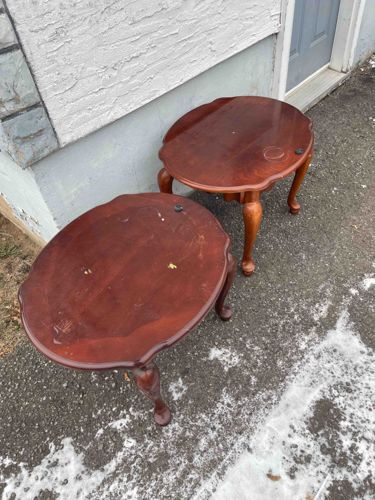
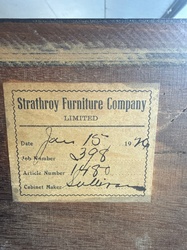
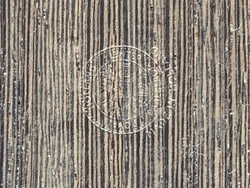
This is a pair of matching wooden end tables, each featuring a scalloped or pie-crust edge top and cabriole legs, indicative of a traditional or Queen Anne style. The tables appear to be constructed from a reddish-brown hardwood, possibly mahogany or cherry, with a glossy finish that shows signs of wear and surface imperfections. Each table has an oval-shaped top with distinctively carved, undulating edges that add a decorative flair. The legs are slender and elegantly curved, terminating in simple, unadorned feet. Both tables exhibit noticeable signs of use and exposure to the elements, including water rings, general surface scratches, and possible fading or discoloration of the finish, particularly evident as lighter patches or marks on the tabletops. One table shows a distinct circular water stain and what might be some residual adhesive or foreign material on its top surface, along with some lighter colored specks. Another table has a few small yellow flecks on its surface, which could be paint or debris. The overall condition suggests that they have been stored outdoors or in a non-climate-controlled environment for some time, leading to accelerated wear. No discernible maker's marks, signatures, or stamps are visible in the provided images. The craftsmanship appears to be standard for mass-produced furniture of this style, likely dating from the mid-20th century, possibly from the 1950s to 1970s, making them vintage rather than antique. The construction appears to be solid, despite the surface wear.
AI Appraisal Report
I have examined the provided images of this pair of scalloped edge end tables. Based on my visual assessment, these tables exhibit a traditional or Queen Anne style, characterized by their pie-crust edge tops and cabriole legs. The reddish-brown hardwood, likely mahogany or cherry, suggests a mid-20th century production, probably between the 1950s and 1970s. This places them firmly in the vintage category rather than antique. Without physical inspection, I cannot definitively confirm the wood type, construction methods (e.g., solid wood vs. veneer), or internal structural integrity.
The condition is a significant factor impacting value. Both tables show substantial wear, including numerous surface scratches, distinct water rings, fading, and discoloration. One table clearly exhibits a prominent circular water stain and what appears to be adhesive residue, while the other has yellow flecks. These imperfections suggest a history of inconsistent care or prolonged exposure to non-optimal environments. The lack of discernible maker's marks, while not uncommon for mass-produced furniture of this era, limits specific attribution and thus potential for premium value based on manufacturer reputation.
Market conditions for vintage mass-produced furniture of this type are generally moderate. While the Queen Anne style has enduring appeal, the condition of these particular tables significantly reduces their market desirability and potential resale value. Comparables would include similar vintage end tables found in antique malls, consignment shops, or online marketplaces, often priced based on their decorative appeal rather than investment potential. Demand is moderate for functional, decorative pieces, but severe condition issues deter higher-end buyers.
Factors significantly impacting value are primarily the poor surface condition and lack of provenance. Extensive restoration, including refinishing, would be required to significantly improve their aesthetic and market value, but the cost of such restoration might exceed the tables' inherent worth. For full authentication and to ascertain internal condition or wood quality, a physical examination, potentially including internal structure analysis and wood identification, would be necessary.