AI estimate as of September 29, 2025 · verify with a professional before acting
AI-Generated · Verify before acting
Everything on this page is generated by AI for informational purposes only. AI can make mistakes — the AI may misidentify items or misattribute them (artist, maker, brand, designer, origin, era). This is not an official valuation and should not be used for insurance, sale, tax, estate, legal, or lending purposes — or any decision requiring a certified appraisal. It is not an authoritative claim about any person, brand, or rights holder — do not share or rely on it as a factual statement about a third party. Always consult qualified professionals before making financial decisions.
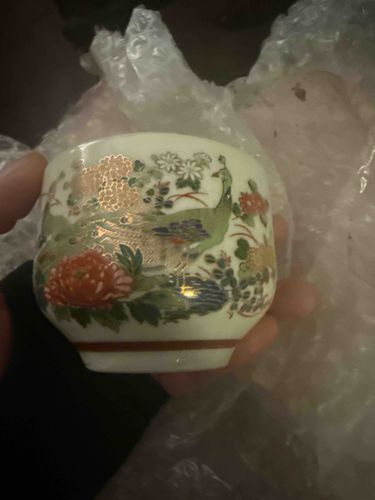
This item is a small, hand-painted porcelain cup, likely a Japanese teacup (yunomi) or a sake cup (sakazuki). Its base color is a creamy white or off-white porcelain, providing a bright canvas for the intricate polychrome and gilt decoration. The primary motif features a beautifully rendered peacock with prominent green and blue plumage, perched amidst a lush landscape of traditional Japanese flora. Large, vibrant red and orange chrysanthemums and peonies are visible, alongside other smaller floral elements and foliage in shades of green, rust, and subtle blues. Gold gilt is extensively used to highlight details, such as the peacock's feathers, the outlines of flowers, and sections of the foliage, adding a luxurious shimmer to the design. The cup has a slightly flared rim and a gently tapering body, resting on a small footring. A thin, reddish-brown band encircles the base of the cup, just above the foot. The delicate details and use of rich colors, particularly the red, gold, and green, are characteristic of Imari ware, a style that originated in Arita, Japan. While specific maker's marks are not visible from the provided image, the craftsmanship suggests a late 19th to mid-20th-century production, given its style and detail. The visible surface appears largely intact, though minor wear to the gilt or paint could be present upon closer inspection, which is common for items of this age. There are no immediately obvious chips, cracks, or repairs, indicating a well-preserved condition. The quality of the hand-painting, particularly the fine lines and color application, points to a good standard of craftsmanship.
AI Appraisal Report
Upon visual examination of this Japanese porcelain cup, I have assessed it to be a fine example of Imari-style ware, likely dating from the late Meiji to Taisho period (late 19th to early 20th century). The hand-painted decoration featuring a peacock amidst peonies and chrysanthemums is characteristic of this style, with a vibrant polychrome palette and extensive use of gold gilt. Based on the provided image, the cup appears to be in very good condition, showing no obvious chips, cracks, or repairs. The gilt and enamels seem well-preserved, which is a significant factor in its value.
The market for Japanese porcelain of this type is stable, with consistent interest from collectors. Similar single Imari cups from this period, demonstrating good craftsmanship but without a definitive maker's mark, typically sell in the range of $50 to $100 at auction and in retail settings. The intricate and well-executed peacock motif enhances its desirability. The value is primarily driven by its decorative quality and condition rather than exceptional rarity, as single cups are more common than complete sets.
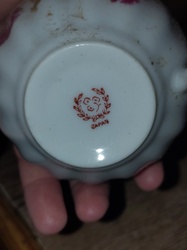
However, this appraisal is limited by the use of digital images. For a full authentication, an in-person examination is essential to inspect for maker's marks on the footring, assess the texture of the porcelain and glaze, and confirm the absence of hairline cracks or subtle repairs under UV light. Without physical inspection or provenance, attributing it to a specific Arita kiln or artisan is not possible, and its authenticity as a period piece versus a later reproduction cannot be definitively confirmed.