AI estimate as of August 31, 2025 · verify with a professional before acting
AI-Generated · Verify before acting
Everything on this page is generated by AI for informational purposes only. AI can make mistakes — the AI may misidentify items or misattribute them (artist, maker, brand, designer, origin, era). This is not an official valuation and should not be used for insurance, sale, tax, estate, legal, or lending purposes — or any decision requiring a certified appraisal. It is not an authoritative claim about any person, brand, or rights holder — do not share or rely on it as a factual statement about a third party. Always consult qualified professionals before making financial decisions.
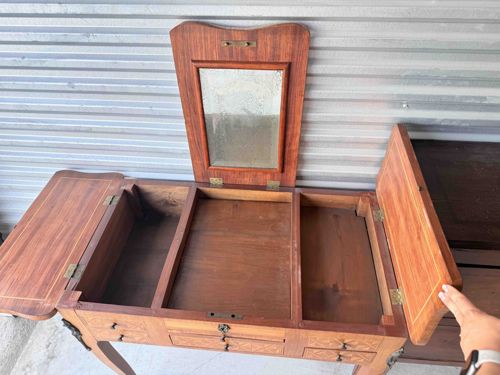
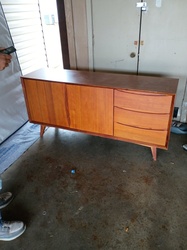
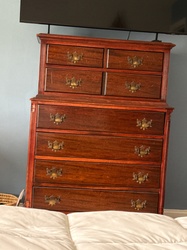
This item is an antique or vintage wooden vanity or dressing table, likely crafted from mahogany or a similar rich, reddish-brown hardwood. The overall design suggests a late 19th or early 20th-century style, possibly Art Nouveau or Edwardian, due to its delicate curves and intricate details. The vanity features a central lift-up panel that reveals a mirror on its underside, allowing it to function as a hidden dressing table. Below this central compartment, there are two additional lidded compartments, one on either side, suggesting storage for toiletries, jewelry, or cosmetics. The lids of these side compartments, as well as the central mirror panel, are hinged and show signs of brass or bronze hardware that has developed a patina over time. The main body of the table features multiple small drawers, intricately decorated with what appears to be inlaid patterns or carved motifs, possibly resembling a basketweave or geometric design. These drawers have small, presumably metal, pulls. The table is supported by elegant, curved legs, characteristic of period furniture. Decorative metal accents, possibly escutcheons or mounts, are visible where the legs meet the main body of the table. The wood exhibits a discernible grain and a polished finish, though there are visible signs of wear consistent with age, including scratches, minor dings, and potential fading of the finish in areas. The mirror itself shows significant silvering degradation and cloudiness, indicating its age and suggesting a need for re-silvering if restoration is desired. The craftsmanship appears to be of good quality, with tight joinery and attention to decorative detail, indicating a piece made by skilled artisans rather than mass production.
AI Appraisal Report
Based on my visual examination of the provided image, this antique/vintage vanity or dressing table exhibits characteristics consistent with late 19th to early 20th-century craftsmanship, likely Edwardian or early Art Nouveau. The dark wood, probably mahogany or a similar hardwood, along with the curved lines and decorative inlays/carvings on the drawers, speak to its period. The ingenious hidden mirror mechanism and multiple compartments are desirable features.
The condition appears fair to good for its age. I observe typical wear such as surface scratches, minor dings, and potential fading, all consistent with a well-used antique. A significant factor impacting value is the heavily degraded mirror, which will require re-silvering or replacement to restore functionality and aesthetic appeal. The brass/bronze hardware shows appropriate patina.
Market conditions for furniture of this style are currently moderate. While there's steady demand for functional and aesthetically pleasing antique pieces, condition issues like the mirror degradation will limit its top-tier value compared to fully restored examples. Comparables typically include similar hidden-mirror vanities from the period, with values varying widely based on wood species, intricacy of design, and overall condition. The quality of craftsmanship appears high, indicating a skilled artisan's work, which enhances its appeal.
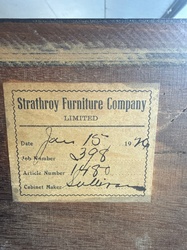
Demand for unique, multi-functional pieces remains consistent, and the hidden mirror feature adds a layer of rarity and charm. However, without a physical inspection, certain details remain speculative. I cannot definitively confirm the wood type, the exact nature of the inlays vs. carvings, or the material of the metal accents. Authentication of age is based on style and apparent wear, but provenance documentation would be ideal. Physical examination would allow me to assess joinery, structural integrity, and the full extent of surface imperfections, all crucial for a precise valuation. Specialized tools could verify wood species and inlay methods. Therefore, this valuation is based solely on visual analysis and stylistic attributes.