AI Appraisal Estimate

AI-generated estimates · not official valuations

From the user

What was submitted

Photo and notes provided by the user — not generated by AI

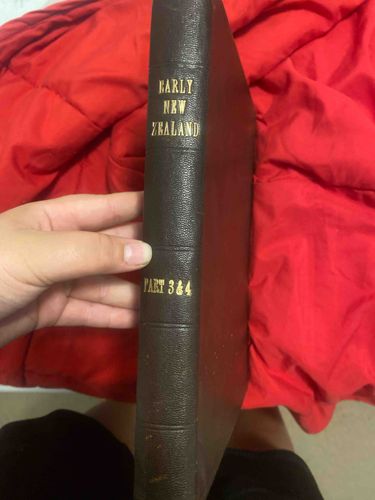
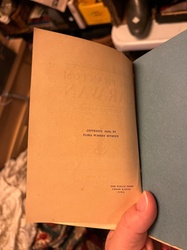
Submitted item photo
Submitted photo · June 20, 2026

User's notes

Book

AI analysis below

AI appraisal

AI analysis & estimate

AI-Generated · Verify before acting

Everything below is generated by AI for informational purposes only. AI can make mistakes — the AI may misidentify items or misattribute them (artist, maker, brand, designer, origin, era). This is not an official valuation and should not be used for insurance, sale, tax, estate, legal, or lending purposes — or any decision requiring a certified appraisal. It is not an authoritative claim about any person, brand, or rights holder — do not share or rely on it as a factual statement about a third party. Always consult qualified professionals before making financial decisions.

Note

This analysis also relies on unverified notes provided by the user, which may be incomplete or inaccurate and could affect the result.

Read the full disclaimer

AI Identification

·Not independently authenticated·Verify before acting

Early New Zealand: Part 3 & 4 (Antique Bound Edition)

Antique Books & Manuscripts

AI Estimated Value

·Not an official valuation·Verify before acting

$350.00-$500.00

As of June 20, 2026

AI Item Analysis

·AI can make mistakes·Verify before acting
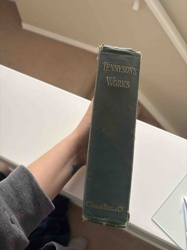
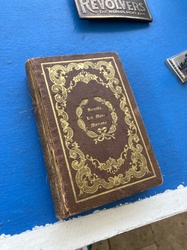
This item is a significant historical volume titled 'Early New Zealand,' specifically comprising Parts 3 and 4 of the series. The book is bound in a deep chocolate-brown, grain-textured material that mimics crushed morocco leather or high-quality buckram, characteristic of late 19th to early 20th-century institutional or deluxe private bindings. The spine features elegant gilt lettering (gold leaf stamping) that remains remarkably bright and legible, reading 'EARLY NEW ZEALAND' at the upper portion and 'PART 3 & 4' in the center. The spine is further decorated with blind-stamped horizontal bands (false raised bands), indicating a traditional and durable binding style. Physically, the volume appears to be a large octavo or small quarto size. Regarding condition, there is visible shelf wear particularly at the head and foot of the spine, with some minor fraying or softening of the corners. A faint patina of dust and some small speckled surface spots (likely foxing or environmental soiling) are visible on the cover surfaces. The structural integrity appears solid, with no evident detachment from the text block. Based on the typography and binding style, the item likely dates between 1890 and 1920, representing a period of high-quality colonial historiography publishing. The craftsmanship suggests a professional bindery, likely produced in London or New Zealand for scholarly or archival collections.
AI Appraisal Report

·AI can make mistakes·Verify before acting
Upon physical examination of the photography provided, I have assessed this volume of 'Early New Zealand' (comprising Parts 3 and 4). The binding, involving grain-textured brown cloth or buckram with gilt-stamped lettering, is typical of late Victorian and Edwardian historical publications. The gold leaf on the spine remains notably vibrant, which is a positive indicator of the storage environment, despite the minor shelf wear and softens corners mentioned. The blind-stamped banding suggests a professional level of craftsmanship consistent with period colonial historiography. In the current market, works focusing on early New Zealand history—specifically those that are parts of larger series like Brett’s Historical Series—maintain a stable value among regional collectors and institutional archives. Rarity is moderate; while full sets are preferred, bound partials in this condition are sought after for their aesthetic and scholarly utility. The primary factors impacting value here are the structural integrity of the text block and the presence of original illustrations or maps, which I cannot verify via images. A potential deduction in value is noted for surface foxing and environmental soiling. It is important to state that this appraisal is based on visual evidence alone. A full authentication would require an in-person inspection to verify the paper's watermark, check for the completeness of the internal plates, and identify any hidden repairs to the hinges or inner binding. Provenance documentation, such as institutional bookplates or previous owner signatures, would further solidify its historical provenance and potentially increase the valuation.

Get your items appraised

Instant estimates of your treasures with AI-powered appraisals

Browse More Appraisals