AI estimate as of September 3, 2025 · verify with a professional before acting
AI-Generated · Verify before acting
Everything on this page is generated by AI for informational purposes only. AI can make mistakes — the AI may misidentify items or misattribute them (artist, maker, brand, designer, origin, era). This is not an official valuation and should not be used for insurance, sale, tax, estate, legal, or lending purposes — or any decision requiring a certified appraisal. It is not an authoritative claim about any person, brand, or rights holder — do not share or rely on it as a factual statement about a third party. Always consult qualified professionals before making financial decisions.
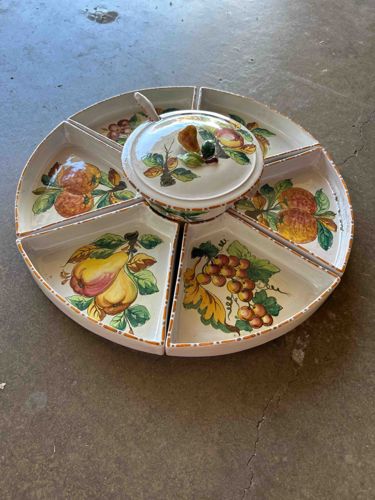
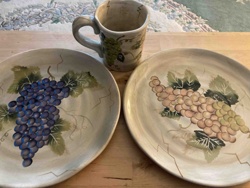
This item is a segmented ceramic or earthenware serving platter with a central lidded bowl, designed for serving various food items simultaneously. The platter is circular in overall shape and comprises five wedge-shaped compartments surrounding a central rounded lidded bowl. Each of the six individual pieces (five wedges and the central lidded bowl) is independently painted with vibrant fruit motifs, suggesting a Mediterranean or Italian country style. The fruits depicted include apples, pears, and grapes, rendered in a colorful and somewhat naive hand-painted style with prominent green leaves and brown stems. The edges of all components feature a distinct decorative rim in alternating orange-brown and beige dashes, giving it a rustic or distressed appearance. The base color of the ceramic is a light cream or off-white. The central bowl has a fitted lid with a small knob or handle which is also painted with similar fruit designs. A small serving spoon, appearing to be crafted from the same material and with a matching finish, protrudes from the central bowl. The glazed finish gives the piece a glossy sheen, indicative of ceramic or earthenware material. Despite the vibrant painting, there appears to be some minor surface wear consistent with age and use, though no significant cracks or chips are immediately visible. The craftsmanship suggests it is hand-painted, contributing to its unique character. This type of serveware was popular in the mid-20th century, often associated with casual dining or garden parties. The quality appears to be consumer-grade, though charmingly executed.
AI Appraisal Report
Based on my visual examination of the provided image, this segmented ceramic serving platter with a lidded central bowl presents in good overall condition. The vibrant, hand-painted fruit motifs, characteristic of Mediterranean or Italian country style, appear largely intact with only minor surface wear consistent with age and use. I observe no obvious cracks, chips, or significant crazing that would detract heavily from its appeal, though a glossy glaze can sometimes mask minor imperfections. The unique decorative dashed rim and the charmingly naive fruit renderings contribute to its aesthetic. Authenticity as a period piece, likely mid-20th century, seems consistent with the design and apparent craftsmanship; this type of casual serveware was popular during that era.
Market conditions for consumer-grade vintage dinnerware like this are largely driven by decorative appeal rather than intrinsic rarity or high-end craftsmanship. Comparables typically sell in the 'vintage kitchenware' or 'hand-painted ceramics' categories. Demand is moderate, appealing to collectors of vintage housewares or those seeking decorative pieces for rustic or country-themed decor. The item is not rare, and while charming, it doesn't represent a highly collectible artisan piece. Factors that positively impact value are its completeness (all segments, lid, and spoon), good condition, and charming hand-painted aesthetic. Conversely, its mass-produced nature (albeit hand-decorated) and lack of a definitive maker's mark or provenance limit its top-tier value.
My valuation is based solely on visual assessment from the image. For full authentication and a more definitive appraisal, an in-person examination would be crucial to physically inspect for hairline cracks, chips disguised by the glaze, actual surface wear not evident in the photo, and to feel the weight and texture for a definitive material assessment (e.g., higher quality earthenware vs. simpler ceramic). Furthermore, examining the base for any maker's marks or stamps, even if simple, could provide stronger provenance. Without physical inspection, the precise dating of the piece remains an informed estimate within the mid-20th century range, and the absence of provenance documentation prevents confirmation of its specific origin or if it's potentially a vintage reproduction of an older style.