AI estimate as of December 3, 2025 · verify with a professional before acting
AI-Generated · Verify before acting
Everything on this page is generated by AI for informational purposes only. AI can make mistakes — the AI may misidentify items or misattribute them (artist, maker, brand, designer, origin, era). This is not an official valuation and should not be used for insurance, sale, tax, estate, legal, or lending purposes — or any decision requiring a certified appraisal. It is not an authoritative claim about any person, brand, or rights holder — do not share or rely on it as a factual statement about a third party. Always consult qualified professionals before making financial decisions.
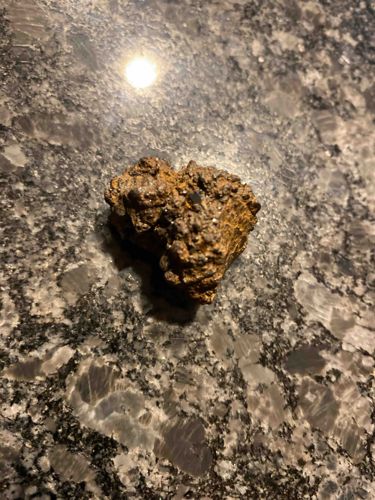
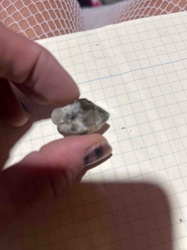
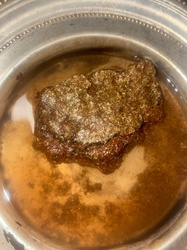
The item is a small, irregularly shaped mineral specimen, primarily exhibiting a dull, dark brown to reddish-brown coloration, consistent with oxidized metals or iron-rich minerals. Its surface is highly textured and rough, characterized by numerous small, angular protrusions and depressions, giving it a somewhat botryoidal or mammillary appearance in certain areas, though without distinct spherical formations. Interspersed within the brown matrix are visible specks and small crystalline formations of a reflective, silvery-gray metallic material, strongly suggesting the presence of a metal, possibly iron, nickel, or a similar alloy, which may or may not be magnetic. The overall size appears to be small, likely fitting within the palm of a hand, though no definitive scale is provided. There are no discernible markings, signatures, or manufacturing details. The item exhibits no visible signs of repair or significant damage beyond its natural, rugged formation. The luster of the metallic flecks is sub-metallic to metallic. Given its unrefined appearance and composition, it is likely a natural geological specimen, possibly a type of ore, a small meteorite fragment (though further analysis would be needed to confirm this), or a piece of industrial slag. Its estimated age is geological, or, if industrial, contemporary, but primarily it appears to be a natural formation. The quality indicators are in its natural formation and the visual evidence of different mineral inclusions.
AI Appraisal Report
Based on my visual examination of the provided description, this Unidentified Metallic Mineral Specimen presents as a natural geological formation, likely an iron-rich ore or a similar oxidized metallic mineral. The dull dark brown to reddish-brown coloration, rough texture, and visible silvery-gray metallic flecks are consistent with such materials. Its condition appears natural and unaltered, with no signs of repair or artificial damage; its rugged formation is inherent to its nature.
Authenticity, solely based on this description, leans towards it being a genuine natural specimen. However, without a physical examination, I cannot definitively rule out industrial slag, though the description's emphasis on "botryoidal or mammillary appearance in certain areas" and "small crystalline formations" suggests natural origins over typical slag characteristics.
Market conditions for such unrefined, uncharacterized mineral specimens are generally modest. Comparables would include common iron ore samples, hematite, or goethite specimens, which typically fetch low prices unless they exhibit exceptional crystal formations, size, or unique aesthetic qualities. This specimen, while interesting, does not appear to possess features that would significantly elevate its aesthetic or scientific value to a broad collector base.
Demand for unidentified, small, weathered metallic mineral specimens is low. Rarity is difficult to assess without identification; if it were a rare meteorite fragment, value would skyrocket, but visual evidence alone is insufficient for such a determination. Factors limiting its value include its unknown composition, small size, and lack of refined beauty.
To fully authenticate and determine its precise value, in-person examination is crucial. This would involve specific gravity tests, streak tests, hardness tests, and potentially magnetic susceptibility. X-ray diffraction (XRD) or scanning electron microscopy/energy-dispersive X-ray spectroscopy (SEM/EDS) would be needed to identify its exact mineralogy and elemental composition. Furthermore, a thin section analysis could determine its internal structure, critical for meteorite identification. Without these, the appraisal remains speculative, resting on its common appearance.