AI Appraisal Estimate

AI-generated estimates · not official valuations

From the user

What was submitted

Photo and notes provided by the user — not generated by AI

Submitted item photo
Submitted photo · June 6, 2026

User's notes

No additional notes provided.

AI analysis below

AI appraisal

AI analysis & estimate

AI-Generated · Verify before acting

Everything below is generated by AI for informational purposes only. AI can make mistakes — the AI may misidentify items or misattribute them (artist, maker, brand, designer, origin, era). This is not an official valuation and should not be used for insurance, sale, tax, estate, legal, or lending purposes — or any decision requiring a certified appraisal. It is not an authoritative claim about any person, brand, or rights holder — do not share or rely on it as a factual statement about a third party. Always consult qualified professionals before making financial decisions.

Read the full disclaimer

AI Identification

·Not independently authenticated·Verify before acting

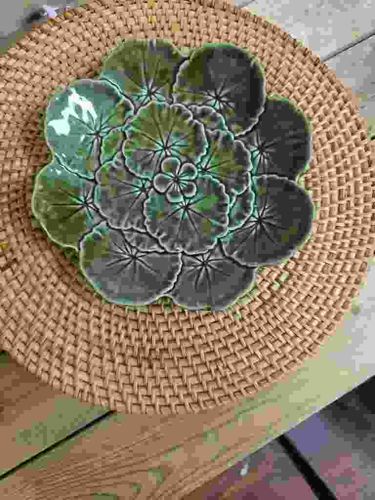
Majolica Geranium Leaf Plate

Antique Ceramics & Collectibles

AI Estimated Value

·Not an official valuation·Verify before acting

$125.00 - $175.00

As of June 6, 2026

AI Item Analysis

·AI can make mistakes·Verify before acting
This is a vintage or antique Majolica-style ceramic plate featuring a highly decorative, molded relief pattern of overlapping geranium leaves. The plate exhibits the characteristic rich, translucent lead glazes associated with Majolica earthenware, prominently featuring varying shades of emerald and forest green with darker, brownish-black central accents on the leaves to provide depth and realism. The construction is heavy and tactile, with deeply impressed veining running from the centers to the scalloped, leaf-shaped edges. At the very center, there is a small, five-petaled flower detail that serves as the focal point. The surface shows a high-gloss finish typical of high-quality glazing, which highlights the dimensional texture of the ceramic body. In terms of condition, there appears to be minor expected wear consistent with age, though no large chips or cracks are immediately visible from the top view; however, traditional Majolica of this era (likely mid-to-late 19th century or early 20th century) often shows fine crazing in the glaze upon close inspection. Similar pieces were famously produced by makers such as Bordallo Pinheiro or Etruscan Majolica (Griffen, Smith & Hill), though a definitive maker's mark would likely be found on the underside. The craftsmanship is evident in the precise alignment of the leaves and the vibrant, organic color transition.
AI Appraisal Report

·AI can make mistakes·Verify before acting
Based on my visual examination of this ceramic plate, it appears to be a classic example of Victorian-era Majolica-style earthenware, likely dating to the late 19th or early 20th century. The molded relief of overlapping geranium leaves demonstrates the organic, high-relief aesthetic popularized by European and American potteries. The translucent lead glazes show the characteristic color pooling in the veins, creating the vibrant depth prized by collectors. The gloss finish and the five-petaled central floret suggest a mid-tier production quality, potentially by well-known makers like Bordallo Pinheiro or Etruscan Majolica, though the absence of a visible underside mark prevents a definitive attribution. The current market for Majolica is stable but selective. Common leaf designs have lower scarcity than figurative pieces (animals or complex scenes). This plate’s value is driven by its excellent color retention and the lack of catastrophic damage. However, the anticipated fine crazing and the minor glaze wear noted on the leaf edges are typical of its age and limit the 'museum-grade' valuation. Authenticity verification from photographs alone is limited. While the glaze and relief depth appear consistent with period pieces rather than modern reproductions, a physical inspection is required to check for 'kiln breath' marks, verify the weight of the ceramic body, and examine the foot rim for appropriate wear patterns. A definitive appraisal would require viewing the base markings and testing the glaze for lead content to distinguish it from modern lead-free replicas. Provenance records regarding its history of ownership would further solidify its value within the antique ceramic market.

Get your items appraised

Instant estimates of your treasures with AI-powered appraisals

Browse More Appraisals