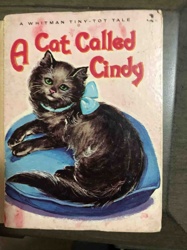
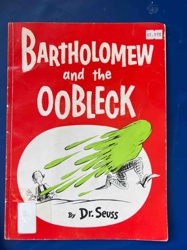
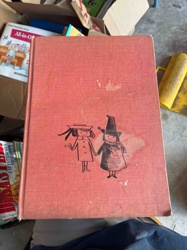
These notes were written by the person who submitted this item. Appraiser.AI has not verified them, and the AI's identification and estimate may rely on them.
AI Estimated Value
Not an official valuation
$5-15
AI estimate as of July 11, 2025 · verify with a professional before acting
AI-Generated · Verify before acting
Everything on this page is generated by AI for informational purposes only. AI can make mistakes — the AI may misidentify items or misattribute them (artist, maker, brand, designer, origin, era). This is not an official valuation and should not be used for insurance, sale, tax, estate, legal, or lending purposes — or any decision requiring a certified appraisal. It is not an authoritative claim about any person, brand, or rights holder — do not share or rely on it as a factual statement about a third party. Always consult qualified professionals before making financial decisions.
This analysis also relies on unverified notes provided by the user, which may be incomplete or inaccurate and could affect the result.
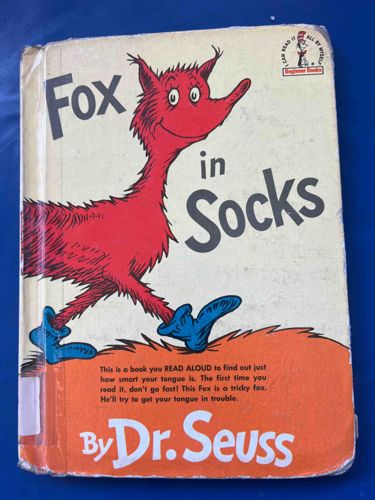
The item is a vintage hardcover children's book titled "Fox in Socks" by Dr. Seuss, featuring a prominent illustration of a red fox character. The front cover is primarily light beige at the top, transitioning to a vibrant orange at the bottom. The title "Fox in Socks" is prominently displayed in large, charcoal-gray letters. The whimsical red fox, characteristic of Dr. Seuss's style, dominates the upper and middle sections of the cover, with its distinctive long snout, large eyes, and scruffy fur. Its feet are adorned with what appear to be blue socks or footwear, contributing to the book's title theme. Just above the fox's feet, a small block of orange text provides a blurb for the book, stating, "This is a book you READ ALOUD to find out just how smart your tongue is. The first time you read it, don't go fast! This Fox is a tricky fox. He'll try to get your tongue in trouble." Below this, the author's name, "By Dr. Seuss," is printed in large, white letters against the orange background. In the upper right corner, a smaller white box with a red border contains a caricature of the Cat in the Hat and text that reads "I CAN READ IT ALL BY MYSELF" and "Beginner Books." The book shows significant signs of age and wear, consistent with an older children's book that has been frequently handled. The corners are softened, and the edges display scuffing and minor tears. The spine appears worn and somewhat faded, indicative of repeated use and possibly a lack of an intact dust jacket. There is a visible white label or sticker residue on the bottom left edge of the front cover, possibly from a library or previous retailer. The overall condition suggests a beloved, well-read copy. The quality of the printing and binding, while showing wear, indicates typical mass-market production for children's books of its era. This particular book is a classic example of Dr. Seuss's work, known for its wordplay and tongue twisters, likely dating from the mid-to-late 20th century.
AI Appraisal Report
I have examined the provided image of the "Fox in Socks" by Dr. Seuss hardcover book. Based on its appearance, this specific copy is a later printing due to the "Beginner Books" imprint and the "I CAN READ IT ALL BY MYSELF" block, and the instructional blurb on the cover, which are common features of mass-market editions from the mid-to-late 20th century. While it is a classic title, this is not a first edition.
The book shows significant signs of age and wear. The softened corners, scuffed edges, minor tears, and worn/faded spine indicate considerable handling and use. The visible label residue on the front cover also suggests it may have been a library copy or well-circulated.
Market conditions for later printings of commonly available children's books like this are generally modest. Comparables in similar worn condition typically sell for low values. Demand is consistent for Dr. Seuss titles, but rarity is not a factor for later printings.
Factors significantly impacting value here are the overall poor condition and its status as a later printing. Had this been a true first edition in excellent condition with a dust jacket, the value would be substantially higher.
Authentication solely from an image is limited. To confirm the exact printing and issue details (which could still marginally affect value), a physical examination of the copyright page, internal illustrations, and binding characteristics would be necessary. Provenance documentation could provide further history, but for this type of book, it's rarely available or impactful. No scientific testing is required for this particular appraisal.