Embedded Foreign Object in Human Skin
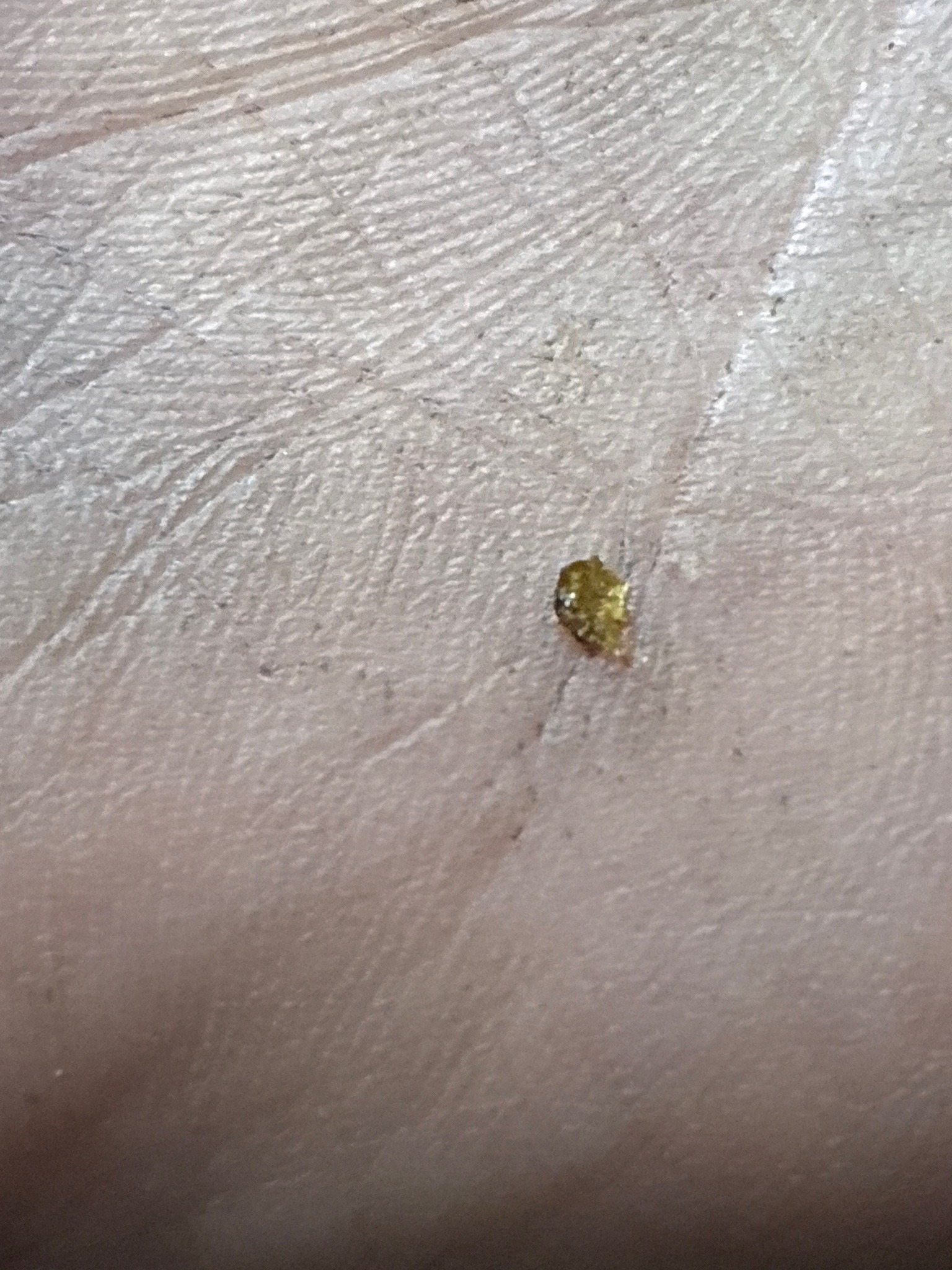
The item depicted is a small, crystalline or glass-like fragment embedded in the superficial layer of human skin, likely an extremity such as a palm or finger based on the visible dermatoglyphic patterns (skin ridges). The object appears to be approximately 1 to 2 millimeters in size. It possesses a yellowish-translucent to amber-green hue with an irregular, angular geometry that suggests a fracture or splinter origin. The texture of the surrounding tissue shows slight raised inflammation or a puncture point where the object entered the dermal layer. There is a lack of significant hemorrhage, suggesting it is resting in the upper epidermal or dermal levels. The object features reflective facets that catch the light, indicating a hard, non-porous material such as glass, resin, or perhaps a mineralized splinter. There are no definitive maker's marks or stamps, as this is an accidental biological inclusion rather than a manufactured specimen. The surrounding skin displays typical texture with fine lines and pores, providing a scale for the minute size of the fragment. No significant infection or suppuration is visible at this stage, though the area immediately adjacent to the object shows slight reddening, typical of a localized foreign body response.
AI-Generated Appraisal Disclaimer
Estimated Value
$50.00 - $150.00
Basic Information
Category
Foreign Body/Medical Case
Appraised On
April 13, 2026
Estimated Value
$50.00 - $150.00
Item Description
The item depicted is a small, crystalline or glass-like fragment embedded in the superficial layer of human skin, likely an extremity such as a palm or finger based on the visible dermatoglyphic patterns (skin ridges). The object appears to be approximately 1 to 2 millimeters in size. It possesses a yellowish-translucent to amber-green hue with an irregular, angular geometry that suggests a fracture or splinter origin. The texture of the surrounding tissue shows slight raised inflammation or a puncture point where the object entered the dermal layer. There is a lack of significant hemorrhage, suggesting it is resting in the upper epidermal or dermal levels. The object features reflective facets that catch the light, indicating a hard, non-porous material such as glass, resin, or perhaps a mineralized splinter. There are no definitive maker's marks or stamps, as this is an accidental biological inclusion rather than a manufactured specimen. The surrounding skin displays typical texture with fine lines and pores, providing a scale for the minute size of the fragment. No significant infection or suppuration is visible at this stage, though the area immediately adjacent to the object shows slight reddening, typical of a localized foreign body response.
Get Your Items Appraised
Instant estimates of your treasures with AI-powered instant appraisals