AI estimate as of August 27, 2025 · verify with a professional before acting
AI-Generated · Verify before acting
Everything on this page is generated by AI for informational purposes only. AI can make mistakes — the AI may misidentify items or misattribute them (artist, maker, brand, designer, origin, era). This is not an official valuation and should not be used for insurance, sale, tax, estate, legal, or lending purposes — or any decision requiring a certified appraisal. It is not an authoritative claim about any person, brand, or rights holder — do not share or rely on it as a factual statement about a third party. Always consult qualified professionals before making financial decisions.
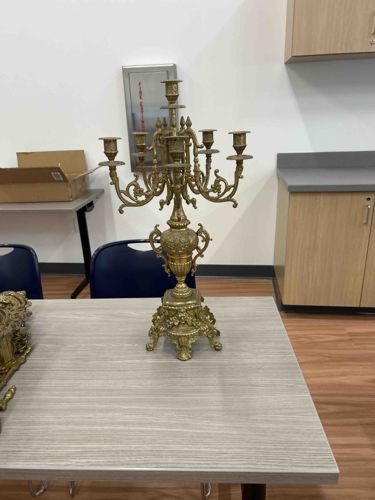
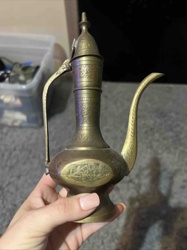
This is a large, ornate candelabra, likely crafted from brass or bronze, judging by its distinctive golden-brown metallic sheen and the visible patina. The candelabra features a central stem supporting multiple candle holders, specifically seven in total, with one elevated in the center and six branching out symmetrically around it. The overall design is highly decorative, characterized by intricate cast details, including scrolling acanthus leaves, floral motifs, and perhaps grapevines on the base, suggesting a possible Rococo or Victorian Revival style. The base is substantial and appears to be squared with rounded corners, elevated on four ornate feet. The central column has a vase-like or urn-shaped section, also heavily adorned with raised decorative elements. The arms supporting the individual candle cups exhibit elegant curves and additional decorative flourishes. The piece displays a rich, aged patina consistent with its likely material and age, suggesting it has not been recently polished, which adds to its antique appeal. There are no obvious signs of significant damage like breaks or deep dents visible, but typical wear consistent with age, such as minor surface imperfections or light scratches, would be expected. The craftsmanship appears to be of high quality, with detailed casting indicative of skilled metalwork. Without specific maker's marks, a precise age is difficult to determine, but the style strongly points to a 19th or early 20th-century origin.
AI Appraisal Report
Based on my visual examination of the provided image, this Seven-Light Ornate Brass/Bronze Candelabra appears to be a well-preserved antique piece. The rich, aged patina is consistent with brass or bronze and suggests it has not been over-cleaned, which is desirable for collectors. I observe no obvious breaks, significant dents, or repairs, indicating good structural integrity. Minor surface imperfections or light scratches would be expected with age but do not detract from its overall appeal. The intricate detailing, including acanthus leaves, floral motifs, and the substantial base, points to a high level of craftsmanship, likely from the 19th or early 20th century, possibly Rococo or Victorian Revival in style.
The authenticity, based purely on imagery, appears strong for a period piece of decorative arts. However, without a physical inspection, I cannot confirm the exact metal composition (brass versus bronze) nor can I definitively rule out expert reproductions. An in-person examination would allow for closer inspection of casting details, weight, and potential maker's marks or stamps, which are crucial for full authentication and dating. Provenance documentation, if available, would significantly enhance authenticity.
In terms of market conditions, ornate candelabras of this size and quality generally hold stable value in the decorative arts sector, appealing particularly to those interested in period interiors or collecting antique metallic objects. Comparables from auction records and reputable dealers suggest similar pieces, depending on their rarity and condition, can fetch a decent price. The 'seven-light' configuration adds to its decorative presence and desirability. While not exceedingly rare, a piece in this apparent condition with such detailed casting is less common than simpler examples. Demand is moderate but consistent for well-preserved, aesthetically pleasing pieces like this. Factors impacting value positively include its good apparent condition, intricate design, and substantial size. The lack of visible maker's marks is common for many period pieces and does not dramatically impact value unless a specific, highly sought-after manufacturer is identified.
To fully verify authenticity and precisely date the item, I would need to handle it, look for hidden marks, and possibly perform metal testing. Without this, my appraisal on authenticity heavily relies on visual cues from the photograph.